Showing posts with label Chinese. Show all posts
Showing posts with label Chinese. Show all posts
Monday, May 9, 2011
Happy Mother's Day!
詩名: 遊 子 吟
作者: 孟 郊 詩體: 樂 府
慈 母 手 中 線 , 遊 子 身 上 衣 。
臨 行 密 密 縫 , 意 恐 遲 遲 歸 。
誰 言 寸 草 心 , 報 得 三 春 暉 ?
Thread in the hand of a loving mother
Is worked into the jacket
of her wayward boy.
Firm and close she sets the stitches now
For she fears he will slow, slow
to return.
Who can say that the heart
of an inch-long grass [i.e., a son]
Will repay the sunlight
of full Spring [i.e., a mother's love]?
Labels:
Chinese,
Culture and News,
Language,
Memoirs and Friends,
Music,
Theology

Friday, March 25, 2011
Deutsch als Vatersprache…
sich mit der Absicht tragen
Seit fast einem Jahrzehnte hat er sich mit der Absicht getragen, Pfaffer zu sein.
sich abspielen
Wo soll diese Geschichte sich abspielen?
auf Abstand gehen
Obwohl er das Buch schon bis zur Hälfte gelesen hat, ist er plötzlich auf Abstand gegangen, und es ins Müll ausgeworfen!
Zeit und Gezeiten warten auf niemand. --> Time and tide wait for no man.
Zeit ist Leben, und Leben ist Zeit. --> Ewiges Leben ist endlose Zeit.
Zeit ist die best Medizin. --> Time heals all wounds…
Zu früh alt, zu spät weise. --> Old too soon, wise too late.
半途而廢 bàn tú ér fèi : A job half-done is not done at all. (一知半覺。)
模棱兩可 mó léng liâng kê : To be of two minds, wishy-washy. (反無常的?)
Seit fast einem Jahrzehnte hat er sich mit der Absicht getragen, Pfaffer zu sein.
sich abspielen
Wo soll diese Geschichte sich abspielen?
auf Abstand gehen
Obwohl er das Buch schon bis zur Hälfte gelesen hat, ist er plötzlich auf Abstand gegangen, und es ins Müll ausgeworfen!
Zeit und Gezeiten warten auf niemand. --> Time and tide wait for no man.
Zeit ist Leben, und Leben ist Zeit. --> Ewiges Leben ist endlose Zeit.
Zeit ist die best Medizin. --> Time heals all wounds…
Zu früh alt, zu spät weise. --> Old too soon, wise too late.
半途而廢 bàn tú ér fèi : A job half-done is not done at all. (一知半覺。)
模棱兩可 mó léng liâng kê : To be of two minds, wishy-washy. (反無常的?)
Wednesday, March 23, 2011
Deutsch als Vatersprache…
abschnallen
Um wieviel Uhr ich gestern eingeschlafen bin, da schnallst du ab. (You'd be flabbergasted at what time I fell asleep last night.)
abschneiden
Bei der Olympiade schnitt ihr Land gut ab. (Her country did well at the Olympics.)
es abgesehen haben
Der Gefreiete glaubte, dass der Feldwebel es auf ihn abgesehen hatte. (The private thought the sergeant had it in for him.)
Zielen ist nicht genug, es gilt treffen. --> Man kann nicht nur einen Plan haben, sondern muss auch imstande sein, die Tat in Schwung zu bringen.
Zeugen sind besser als Urkunden. --> Menschen und Spuren können beide lügen, aber nur die Menschen können auch verleumdet werden, um ihre Wahrheit auszufinden.
Zeitvertreib ist der Anfang von Vergesslichkeit. --> Man muss sich sozusagen vom Anfang daran erinnern, was er machen möchte, bevor er kann sich nur daran erinnern, was er früher gern gemacht hätte. (So Faulkners "Memory speaks before knowing remembers", oder?)
Zeit verloren, Leben verloren. --> Carpe diem! Hic Rhodes, hic salta! Nunc vel nunquam (?).
百步穿楊 / 百發百中。 A sure hand. A masterful display.
Um wieviel Uhr ich gestern eingeschlafen bin, da schnallst du ab. (You'd be flabbergasted at what time I fell asleep last night.)
abschneiden
Bei der Olympiade schnitt ihr Land gut ab. (Her country did well at the Olympics.)
es abgesehen haben
Der Gefreiete glaubte, dass der Feldwebel es auf ihn abgesehen hatte. (The private thought the sergeant had it in for him.)
Zielen ist nicht genug, es gilt treffen. --> Man kann nicht nur einen Plan haben, sondern muss auch imstande sein, die Tat in Schwung zu bringen.
Zeugen sind besser als Urkunden. --> Menschen und Spuren können beide lügen, aber nur die Menschen können auch verleumdet werden, um ihre Wahrheit auszufinden.
Zeitvertreib ist der Anfang von Vergesslichkeit. --> Man muss sich sozusagen vom Anfang daran erinnern, was er machen möchte, bevor er kann sich nur daran erinnern, was er früher gern gemacht hätte. (So Faulkners "Memory speaks before knowing remembers", oder?)
Zeit verloren, Leben verloren. --> Carpe diem! Hic Rhodes, hic salta! Nunc vel nunquam (?).
百步穿楊 / 百發百中。 A sure hand. A masterful display.
Labels:
Chinese,
Deutsch als Vatersprache,
Language
Wednesday, March 9, 2011
Well, I never knew…
From the Wikipedia entry on the history of Xiamen:
As for gung ho?
Xiamen was the port of trade first used by Europeans (mainly the Portuguese) in 1541. It was China's main port in the nineteenth century for exporting tea. As a result, Hokkien (also known as the Amoy dialect) had a major influence on how Chinese terminology was translated into English and other European languages. For example, the words "Amoy", "tea" (茶; tê), "cumshaw" (感謝; kám-siā), and "Pekoe" (白毫; pe̍h-hô), kowtow (磕頭; khàu-thâu), and possibly Japan (Ji̍t-pún) and "ketchup" (茄汁; kiô-chap) originated from the Hokkien.
As for gung ho?
This unofficial motto of the US Marine Corps is an abbreviation for the Mandarin Gongye Hezhoushe (sic [工業合作社 Gongyè Hézuòshè]), or industrial cooperative. The term was used in China, starting in 1938, to refer to small, industrial operations that were being established in rural China to replace the industrial centers that had been captured by the Japanese. The phrase was clipped to the initial characters of the two words, gung ho (or gung he, as it would be transliterated today), which means "work together." …
Enter Lt. Col. Evans Carlson, US Marine Corps. Carlson was a military attache in the US embassy to China in the late-30s. In China, Carlson reported on both the operations of the Chinese army in the field as well as the country's industrial capacity and was favorably impressed by the industrial cooperatives. When he returned to the States and the US entered WWII, Carlson was appointed commander of the 2nd Marine Raider Battalion. Recalling his time in China, Carlson chose gung ho as the motto for his elite battalion and by late 1942 was widely adopted throughout the Marine Corps as an expression of spirit and "can do" attitude.
Deutsch als Vatersprache…
[English is my mother tongue, but I began studying German when I was about 15, i.e. more than half my life, and majored in it in college. I have dreamt in German, been drunk in German, taught and learned in German, even made a girlfriend in German, oh those many years ago. I love the German language. And so I consider it my "father tongue."
As it stands, however, I have been in Taiwan so long now, and have spent so much cognitive energy on learning Chinese, that my German has fallen behind. So I decided I will work through a couple books I have –– German Idioms, Henry Strutz (ed.) and 德漢諺語詞典 (A Chinese Dictionary of German Sayings) 常和芳 編著 –– as a personal refresher. I will start from the front of Strutz's book and from the end of 常's, and may provide brief glosses on the sayings, so I can practice writing a little German on a hopefully daily basis.
Not a very reader-friendly series, I know. Then again, maybe you know Deutsch, or maybe you'll just like seeing it happen!]
das A und O
Das A und O beim Studium der Philosophie ist, erst die richtige Frage zu stellen.
aasen
Obwohl ich Bücher jeden Tag tagelang lesen möchte, dennoch kann ich mit meiner Gesundheit nicht so aasen!
ab nach Kassel
Mitschüler, ab nach Kassel––sonst erwischt uns der Lehrer!
Zwischen zwei Bergen liegt immer ein Tal. --> Doch haben die höchste Erlebnisse im Leben ihrer negativen und vielleicht gefährlichen Aspekte.
Zwischen Kummer and Freude liegt nur Haaresbreite. --> Im Menschenleben ist es immer möglich, dass der Angst sich plötzlich in die Freude und die Glücklichkeit sich in den Kummer verwandeln.
Zweite Ehe, aufgewährmtes Mahl. --> Nichts ist so süß als die erste Liebe und im allgemein kann kein Erlebnis mit dem ersten Mal vergleichen.
As it stands, however, I have been in Taiwan so long now, and have spent so much cognitive energy on learning Chinese, that my German has fallen behind. So I decided I will work through a couple books I have –– German Idioms, Henry Strutz (ed.) and 德漢諺語詞典 (A Chinese Dictionary of German Sayings) 常和芳 編著 –– as a personal refresher. I will start from the front of Strutz's book and from the end of 常's, and may provide brief glosses on the sayings, so I can practice writing a little German on a hopefully daily basis.
Not a very reader-friendly series, I know. Then again, maybe you know Deutsch, or maybe you'll just like seeing it happen!]
das A und O
Das A und O beim Studium der Philosophie ist, erst die richtige Frage zu stellen.
aasen
Obwohl ich Bücher jeden Tag tagelang lesen möchte, dennoch kann ich mit meiner Gesundheit nicht so aasen!
ab nach Kassel
Mitschüler, ab nach Kassel––sonst erwischt uns der Lehrer!
Zwischen zwei Bergen liegt immer ein Tal. --> Doch haben die höchste Erlebnisse im Leben ihrer negativen und vielleicht gefährlichen Aspekte.
Zwischen Kummer and Freude liegt nur Haaresbreite. --> Im Menschenleben ist es immer möglich, dass der Angst sich plötzlich in die Freude und die Glücklichkeit sich in den Kummer verwandeln.
Zweite Ehe, aufgewährmtes Mahl. --> Nichts ist so süß als die erste Liebe und im allgemein kann kein Erlebnis mit dem ersten Mal vergleichen.
Saturday, March 5, 2011
Put me through the ringer…
My gf recently grilled me on a grammar point in Chinese which has always given me trouble… and it was a kind of crucifixion.
I'm keeping these notes here for reference… and as proof that I do now understand the grammar point… after years of uncertainty.
God, Lord, Jesus, my Messiah––sometimes I HATE LEARNING CHINESE!
(She is Y, I am X.)
[2011/3/5 上午 1:37:10] X: ....的→形容詞 ...得→verb.+得=adv.
[2011/3/5 上午 1:37:50] Y: →
[2011/3/5 上午 1:38:02] X: ....地→ adj.→adv.
[2011/3/5 上午 1:38:34] X: 可愛_____
[2011/3/5 上午 1:38:43] X: 走___到
[2011/3/5 上午 1:38:48] X: 上___去
[2011/3/5 上午 1:38:53] X: 漂亮___
[2011/3/5 上午 1:39:00] X: 肥胖____
[2011/3/5 上午 1:39:30] Y: 的, 得,得 , 的,的
[2011/3/5 上午 1:40:34] Y: 可愛的小孩
[2011/3/5 上午 1:40:52] Y: 雖然走得到,可是路很陡
[2011/3/5 上午 1:40:58] X: 他沒有喝酒,所以看___非常清楚
[2011/3/5 上午 1:41:19] Y: 你腳怎麼痛你還上得去嗎
[2011/3/5 上午 1:41:34] Y: 漂亮的瀑布
[2011/3/5 上午 1:42:13] Y: 肥胖的小豬特別好吃
[2011/3/5 上午 1:42:50] Y: 他沒有喝酒,所以看得非常清楚
[2011/3/5 上午 1:43:32] X: 非常了___
[2011/3/5 上午 1:43:56] Y: 非常了得
[2011/3/5 上午 1:44:06] Y: 了不起
[2011/3/5 上午 1:44:07] Y: ?
[2011/3/5 上午 1:45:06] X: 排了半天的隊=排隊排了半天
[2011/3/5 上午 1:46:02] Y: (we) waited for half a day, if (we) wait (we'll) wait half a day
[2011/3/5 上午 1:47:45] X: 講話講了一整天
[2011/3/5 上午 1:48:38] Y: 講了整天的話
[2011/3/5 上午 1:48:40] Y: 吧
[2011/3/5 上午 1:49:34] Y: 講了一整天的話
[2011/3/5 上午 1:49:53] X: 跳了一整天的舞
[2011/3/5 上午 1:50:14] Y: 跳舞跳了一整天
[2011/3/5 上午 1:50:26] X: 抽了一整包菸
[2011/3/5 上午 1:51:20] Y: 抽菸抽了一整包
[2011/3/5 上午 1:51:20] X: 昨天我走路走了一整天,想要去買一瓶酒,結果問了五十個人,沒有人找___到正確___位置,真___氣死我了!
[2011/3/5 上午 1:56:45] Y: 昨天我走了一整天的路,想要去買一瓶酒,結果問了五十個人,沒有人找得到正確的位置,真的氣死我了!
[2011/3/5 上午 1:58:03] Y: 昨天我走了一整天的路,想要去買一瓶酒,結果問了五十個人,沒有人找到正確的位置了,真的氣死我了!
[2011/3/5 上午 2:00:55] X: 結果問人問了五十個 … 9.5
I'm keeping these notes here for reference… and as proof that I do now understand the grammar point… after years of uncertainty.
God, Lord, Jesus, my Messiah––sometimes I HATE LEARNING CHINESE!
[7 March 2011 ADDENDUM: I was being overly pouty, so, in retrospect, the emphasis should be on "sometimes," not on "hate."]
(She is Y, I am X.)
[2011/3/5 上午 1:37:10] X: ....的→形容詞 ...得→verb.+得=adv.
[2011/3/5 上午 1:37:50] Y: →
[2011/3/5 上午 1:38:02] X: ....地→ adj.→adv.
[2011/3/5 上午 1:38:34] X: 可愛_____
[2011/3/5 上午 1:38:43] X: 走___到
[2011/3/5 上午 1:38:48] X: 上___去
[2011/3/5 上午 1:38:53] X: 漂亮___
[2011/3/5 上午 1:39:00] X: 肥胖____
[2011/3/5 上午 1:39:30] Y: 的, 得,得 , 的,的
[2011/3/5 上午 1:40:34] Y: 可愛的小孩
[2011/3/5 上午 1:40:52] Y: 雖然走得到,可是路很陡
[2011/3/5 上午 1:40:58] X: 他沒有喝酒,所以看___非常清楚
[2011/3/5 上午 1:41:19] Y: 你腳怎麼痛你還上得去嗎
[2011/3/5 上午 1:41:34] Y: 漂亮的瀑布
[2011/3/5 上午 1:42:13] Y: 肥胖的小豬特別好吃
[2011/3/5 上午 1:42:50] Y: 他沒有喝酒,所以看得非常清楚
[2011/3/5 上午 1:43:32] X: 非常了___
[2011/3/5 上午 1:43:56] Y: 非常了得
[2011/3/5 上午 1:44:06] Y: 了不起
[2011/3/5 上午 1:44:07] Y: ?
[2011/3/5 上午 1:45:06] X: 排了半天的隊=排隊排了半天
[2011/3/5 上午 1:46:02] Y: (we) waited for half a day, if (we) wait (we'll) wait half a day
[2011/3/5 上午 1:47:45] X: 講話講了一整天
[2011/3/5 上午 1:48:38] Y: 講了整天的話
[2011/3/5 上午 1:48:40] Y: 吧
[2011/3/5 上午 1:49:34] Y: 講了一整天的話
[2011/3/5 上午 1:49:53] X: 跳了一整天的舞
[2011/3/5 上午 1:50:14] Y: 跳舞跳了一整天
[2011/3/5 上午 1:50:26] X: 抽了一整包菸
[2011/3/5 上午 1:51:20] Y: 抽菸抽了一整包
[2011/3/5 上午 1:51:20] X: 昨天我走路走了一整天,想要去買一瓶酒,結果問了五十個人,沒有人找___到正確___位置,真___氣死我了!
[2011/3/5 上午 1:56:45] Y: 昨天我走了一整天的路,想要去買一瓶酒,結果問了五十個人,沒有人找得到正確的位置,真的氣死我了!
[2011/3/5 上午 1:58:03] Y: 昨天我走了一整天的路,想要去買一瓶酒,結果問了五十個人,沒有人找到正確的位置了,真的氣死我了!
[2011/3/5 上午 2:00:55] X: 結果問人問了五十個 … 9.5
Labels:
Chinese,
Language,
Memoirs and Friends
Thursday, January 27, 2011
東北有三寶。。。
東北有三寶,人蔘,貂皮,烏拉草。
台灣有三寶,檳榔,辣妹,無患子。
美國有三寶,麥粉,當鋪,墨外勞。 (麥當勞?)
The first paragraph of this page contains an explanation for the first line in this post, but the other two lines are whimsical paraphrases, arguably very un-PC, of my own making.
台灣有三寶,檳榔,辣妹,無患子。
美國有三寶,麥粉,當鋪,墨外勞。 (麥當勞?)
The first paragraph of this page contains an explanation for the first line in this post, but the other two lines are whimsical paraphrases, arguably very un-PC, of my own making.
Labels:
Chinese,
Culture and News,
Funny and Random,
Language
Saturday, October 30, 2010
Assonance is as assonance does…
The following is "Pange Lingua" in Chinese.
I go to Eucharistic Adoration nearly every Thursday and we sing the 5th and 6th verses every time. The fifth is the famous "Tantum ergo" verse. When we finished singing last week, I perused the other verses and noticed something remarkable: all the final characters in each stanza of each verse are assonant! As I may have explained before, while I love music, I only have scant musical talent. This means I am easily wowed by most musical accomplishment, as long as it "doesn't completely suck." So, to a real musician and/or songwriter, the assonance (諧音)of the hymn (聖歌)may seem trivial. On the other hand, I consider myself an amateur poet and a compulsive wordsmith, so I am hardly indifferent to the subtleties of rhyme and assonance. Given my credentials, the composition strikes me as a brilliant success.
I will now reproduce the lyrics, but indicate the pronunciation of the final characters:
(Can you guess how to say 阿們?)
Now here is an English translation of the hymn, which I have annotated for assonance and rhyme:
Not a terrible effort, but perhaps you are as struck as I am by how erratic the assonance-scheme is. (Or perhaps my philistinism prevents me from seeing how the scheme is an instance of a genuine poetic device.) With the exception of xuán, diân, and yùe, I find all the assonance in the Chinese version to be much tighter. Further, if we represent the phonetic theme (A, B, etc.) of each verse (1–6) in the Chinese version, we have 1:A, 2:A, 3:B, 4:B, 5:C, and 6:D, compared to at least a dozen different phonemes in the English version. Granted, there may be a more rigorously assonant English version I have not cited, but perhaps now you can see why the assonance of the Chinese struck me so forcefully.
Finally, here is the original Latin for the hymn, in which I shall note the assonance and rhyme.
Arguably, I am being too generous with the Latin by grouping technically distinct sounds under the same phonetic-letter, but, for one thing, Latin is a famously assonant language, so I don't think I'm violating the "phonetic sense" by which "Pange Lingua" was composed, and, second, I was actually being magnanimous in my analysis of the English version by keeping very obliquely assonant phonemes under one heading. Clearly, the Chinese edition strives, and succeeds, to duplicate the assonance of the original Latin; indeed, it seems to have outdone it! I admit this is not a huge shock, considering how homophonic Chinese is, but it was a small breakthrough, or perhaps just a milestone, in my ongoing absorption of Chinese.
Since talk is cheap, I leave you with a fine rendition of the hymn with Latin subtitles (and on a Chinese website, no less!).
1.信友齊來歡呼讚吟,吾主聖體無限情,救世羔羊聖血流傾,贖世犧牲換太平,天地大君榮王天庭,甘受苦難救我靈。
2.聖子降生自取人形,至聖童貞為母親,三十三載天涯飄零,山野海角佈福音,終身橫遭輕慢辱凌,架上七言終其行。
3.耶穌受難前夜晚上,偕諸宗徒聚華堂,遵順古教禮儀習尚,宰殺羔羊分啖嘗,建立聖體罪債普償,洪恩長流澤萬邦。
4.真主真人萬世稱揚,麵形聖化成神糧,酒亦成聖血爵中藏,全信勿疑主榮光,敬禮朝拜耶穌君王,無限深情滿人望。
5.皇皇聖體奧蘊深玄,我眾匍匐主臺前,羔羊聖牲新祭禮獻,摒除古教棄舊典,虔誠全信以至永遠,五官所缺信心堅。
6.聖父聖子聖神尊高,至仁至善萬民朝,齊頌德能神恩豐饒,敬禮讚美共歡躍,天主聖三無限蘊奧,永生永王享榮耀。
阿們。
I go to Eucharistic Adoration nearly every Thursday and we sing the 5th and 6th verses every time. The fifth is the famous "Tantum ergo" verse. When we finished singing last week, I perused the other verses and noticed something remarkable: all the final characters in each stanza of each verse are assonant! As I may have explained before, while I love music, I only have scant musical talent. This means I am easily wowed by most musical accomplishment, as long as it "doesn't completely suck." So, to a real musician and/or songwriter, the assonance (諧音)of the hymn (聖歌)may seem trivial. On the other hand, I consider myself an amateur poet and a compulsive wordsmith, so I am hardly indifferent to the subtleties of rhyme and assonance. Given my credentials, the composition strikes me as a brilliant success.
I will now reproduce the lyrics, but indicate the pronunciation of the final characters:
1. 信友齊來歡呼讚吟 [yin],吾主聖體無限情 [qíng],救世羔羊聖血流傾 [qín],贖世犧牲換太平 [píng],天地大君榮王天庭 [tíng],甘受苦難救我靈 [líng]。
2. 聖子降生自取人形 [xíng],至聖童貞為母親 [qin],三十三載天涯飄零 [lîng],山野海角佈福音 [yin],終身橫遭輕慢辱凌 [líng],架上七言終其行 [xíng]。
3. 耶穌受難前夜晚上 [shàng],偕諸宗徒聚華堂 [táng],遵順古教禮儀習尚 [shàng],宰殺羔羊分啖嘗 [cháng],建立聖體罪債普償 [cháng],洪恩長流澤萬邦 [bang]。
4. 真主真人萬世稱揚 [yáng],麵形聖化成神糧 [liàng],酒亦成聖血爵中藏 [cáng],全信勿疑主榮光 [guang],敬禮朝拜耶穌君王 [wáng],無限深情滿人望 [wàng]。
5. 皇皇聖體奧蘊深玄 [xuán],我眾匍匐主臺前 [qián],羔羊聖牲新祭禮獻 [xiàn],摒除古教棄舊典 [diân],虔誠全信以至永遠 [yuân],五官所缺信心堅 [jian]。
6. 聖父聖子聖神尊高 [gao],至仁至善萬民朝 [cháo],齊頌德能神恩豐饒 [ráo],敬禮讚美共歡躍 [yùe],天主聖三無限蘊奧 [ào],永生永王享榮耀 [yào]。
阿們。
(Can you guess how to say 阿們?)
Now here is an English translation of the hymn, which I have annotated for assonance and rhyme:
Sing, my tongue, the Savior's glory [A],
of His flesh the mystery sing [B];
of the Blood, all price exceeding [B],
shed by our immortal King [B],
destined, for the world's redemption [B?],
from a noble womb to spring [B].
Of a pure and spotless Virgin [C]
born for us on earth below [D],
He, as Man, with man conversing [C],
stayed, the seeds of truth to sow [D];
then He closed in solemn order [E]
wondrously His life of woe [D].
On the night of that Last Supper [F],
seated with His chosen band [G],
He the Pascal victim eating [G?],
first fulfills the Law's command [G];
then as Food to His Apostles [H]
gives Himself with His own hand [G].
Word-made-Flesh, the bread of nature [I]
by His word to Flesh He turns [J];
wine into His Blood He changes [J?];
what though sense no change discerns [J]
Only be the heart in earnest [J?],
faith her lesson quickly learns [J].
Down in adoration falling [K],
This great Sacrament we hail [L],
Over ancient forms of worship [M]
Newer rites of grace prevail [L];
Faith will tell us Christ is present [N],
When our human senses fail [L].
To the everlasting Father [O],
And the Son who made us free [P]
And the Spirit, God proceeding [Q]
From them Each eternally [P],
Be salvation, honor, blessing [Q],
Might and endless majesty [P].
Amen. Alleluia.
Not a terrible effort, but perhaps you are as struck as I am by how erratic the assonance-scheme is. (Or perhaps my philistinism prevents me from seeing how the scheme is an instance of a genuine poetic device.) With the exception of xuán, diân, and yùe, I find all the assonance in the Chinese version to be much tighter. Further, if we represent the phonetic theme (A, B, etc.) of each verse (1–6) in the Chinese version, we have 1:A, 2:A, 3:B, 4:B, 5:C, and 6:D, compared to at least a dozen different phonemes in the English version. Granted, there may be a more rigorously assonant English version I have not cited, but perhaps now you can see why the assonance of the Chinese struck me so forcefully.
Finally, here is the original Latin for the hymn, in which I shall note the assonance and rhyme.
Pange, lingua, gloriosi [A]
Corporis mysterium [B],
Sanguinisque pretiosi [A],
quem in mundi pretium [B]
fructus ventris generosi [A]
Rex effudit Gentium [B].
Nobis datus, nobis natus [C]
ex intacta Virgine [D],
et in mundo conversatus [C],
sparso verbi semine [D],
sui moras incolatus [C]
miro clausit ordine [D].
In supremae nocte coenae [D]
recumbens cum fratribus [E]
observata lege plene [D]
cibis in legalibus [E],
cibum turbae duodenae [D]
se dat suis manibus [E].
Verbum caro, panem verum [B]
verbo carnem efficit [F]:
fitque sanguis Christi merum [B],
et si sensus deficit [F],
ad firmandum cor sincerum [B]
sola fides sufficit [F].
Tantum ergo Sacramentum [B]
veneremur cernui [A*]:
et antiquum documentum [B]
novo cedat ritui [A*]:
praestet fides supplementum [B]
sensuum defectui [A*].
Genitori, Genitoque [D*]
laus et jubilatio [G],
salus, honor, virtus quoque [D*]
sit et benedictio [G]:
Procedenti ab utroque [D*]
compar sit laudatio [G].
Amen. Alleluja.
Arguably, I am being too generous with the Latin by grouping technically distinct sounds under the same phonetic-letter, but, for one thing, Latin is a famously assonant language, so I don't think I'm violating the "phonetic sense" by which "Pange Lingua" was composed, and, second, I was actually being magnanimous in my analysis of the English version by keeping very obliquely assonant phonemes under one heading. Clearly, the Chinese edition strives, and succeeds, to duplicate the assonance of the original Latin; indeed, it seems to have outdone it! I admit this is not a huge shock, considering how homophonic Chinese is, but it was a small breakthrough, or perhaps just a milestone, in my ongoing absorption of Chinese.
Since talk is cheap, I leave you with a fine rendition of the hymn with Latin subtitles (and on a Chinese website, no less!).
Sunday, July 25, 2010
Gym regimen - July 2010
25 July 2010
89kg, BMI 25
A4 workout: Traps, Tris & Shoulders: 80+ mins
(Since most of these exercises are dumbells, but can be done with barbells, I have listed the total weight, not just the weight for each hand.)
Warmup: Calisthenics/stretching... lots of stretching
Dumbbell military press: 12x, 10x, 8x, 6x @ 14kg-36kg/32kg/27kg
Dumbbell upright row: 12x, 10x, 8x, 6x @ 14kg-36kg
"Kowtow" dumbbell reverse flye: 12x, 10x, 8x, 6x @ 14kg-27kg
(I learned this form of the flye from Pac Man [see below], but I made up the name myself. Kowtow is Cantonese for 叩頭 [kou4tou2], which means to bow and 'knock' one's head on the floor in deference to another. You bend down to rest your head on a padded back support, or something around waist height, and do normal flyes in that position. I like these because they also work the neck and abs.)
Shrug: 12x, 10x, 7x, 6x @ 80kg-120kg
Supine triceps extension: 12x, 10x, 8x, 6x @ 14kg-30kg
Elbows-out extension: 12x, 10x, 8x, 6x @ 14kg–27kg
Rope triceps extension: 12x, 10x, 8x, 6x @ 15kg–30kg/25kg (?)
(I'm still too feisty with these, going for too much weight at the expense of clean form. Patience. Humility. Confidence.)
Cooldown:
Rowing shrug: 20x @ 50kg;
Barbell grip: 2x @ 60kg (to failure)
+++
A unique workout today. My friend–-call him Pac Man––invited me to try working out at his gym, a World's Gym. I began the workout a bit antsy, since Pac Man was thirty minutes late for the time he had already asked to shifted from 3:30PM to 4:30PM. In this case, that was like the sun beating the moon to the dawn. At least it gave me time to stretch, And practice that subtlest of old virtues, patience.
Once he got there, I pretended to speak no Chinese at all, sort of on the premise that I was "a new foreigner in town" looking for a gym. I got a 7-day guest pass, but bow howdy what a hoot it was to pretend I understood no Chinese at all! It took me back years! I forgot what it felt like to have Taiwanese people talk about me or just past me to "my Taiwanese friend" and I had to catch myself many times before I let spontaneous Chinese out.
Great Scot, World's Gym is so snazzy compared to Central Power! I knew this going in, but I was struck with mixed feelings by the forgotten novelty of a "nice gym" after so many years of working out at home or outside. The AC was a big adjustment and not entirely welcome. After every set I could feel myself tightening up in the cold air, so I had to keep stretching myself out. On the other hand, the equipment was superb: Ivanko plates! I was initially tripped up by the blend of pound and kilogram weights in the free weight section, but did my best to find the right weight by feel. By far the greatest boon is that World's has a hot tub, sauna, and showers with hot water. The owner of Central sees no reason to turn on hot water during the summer and I don't use hot water when I shower at home, so today it was delicious to get warm and loose in the hot tub, unwind and get clean in the shower, and then cool down with a cold rinse and the AC. After a normal workout, at home or at Central (I have no AC at home, either), I generally sweat for about an hour afterwards, but I am happy to report I had stopped sweating half an hour after today's workout. Such a sexy beast, I know!
Today I tried a new exercise, the elbows-out extension, and I agree they really "work the tris." I did them at a slight incline, instead of prone, like I did my barbell extensions. This exercise and the dumbbell military press showed me in short order how much weaker my left arm is compared to my right arm. I'm left-handed but my throwing, hitting, yanking hand is my right, whereas I use my left hand for writing and smaller motor actions (like entering personal PIN numbers [HT to Erick B.!] or talking on the phone). That's why I love dumbbell exercises: they strip the exercise down to the bone, activate finer, deeper accessory muscles, and display weakness right away by way of wobbly form and uneven weight movement. A barbell can mask asymmetrical weakness as the stronger side shifts its power through the body to compensate for the weaker member, thus keeping the bar's motion basically uniform. Meanwhile the weaker arm is hiding, not growing like it should. This doesn't mean you shouldn't use barbells. I also love barbell exercises, since they tend to concentrate the power on the target muscle without losing effort lot on sloppy form. Every now and then, though, you need to use dumbbells as diagnostic tools. Now that I know my left arm is weaker, when I do barbell tricep exercises, I will add a tiny amount of extra weight to the left side so that over time it will catch up with the right arm. There's a fine analogy for life in the Church in all this, I'm sure… oh, that's right! I Corinthians 11:22ff:
I lost weight on a few exercises compared to my last A4 workout, but my form was much better and I know I worked really hard today. I made yet another big leap with my shrug, partially because I've broken the glass ceiling and realize light shrugs are a waste of time (truly a case of "go heavy or go home"), but also because I used a shoulder-width grip. Two A4 workouts ago, I was gripping the smooth ring-gap between the knurling (now there's a word I'd have never learned if not for BBing!), last A4 I was gripping the inner knurling. A shoulder-width grip gave me more range of motion; if nothing else, they looked good in the mirror! The weight was so heavy in fact, that I had to use a mixed grip (or deadlift grip) to keep the bar from rolling out of my fingers. Grip strength is one of the most essential but most underestimated components of weightlifting. If you can't hold the weight, you can lift it. If you can't hang on to the bar, you can't do another pullup, no matter how much more you lats might be able to do. And so on.
  This is why I think I will start wrapping a towel around the grip for curls, extensions, rows, deadlifts, etc. I could use gloves, but I don't like them (not for now, at least) and the added girth of the towel will do just as much good for my grip. Interestingly enough, while looking for a photo of the deadlift grip, I learned it should only be used for competition weight, while a normal prone grip should be used for training evenly.
My rib injury is annoying but I'll just have to keep working around it. It's not a fracture, just an inflamed muscular lamina, or an intercostal, that must have gotten really poked by the weight belt when I did squats last time. Leg raises don't hurt, so I'll work those a lot next week to get my stomach back up to speed with the rest of my recent gains.
Take heart, I've got a couple "serious posts" about Freud, evolutionary psychology, and memes coming down the barrell, so, always, stay tuned.
89kg, BMI 25
A4 workout: Traps, Tris & Shoulders: 80+ mins
(Since most of these exercises are dumbells, but can be done with barbells, I have listed the total weight, not just the weight for each hand.)
Warmup: Calisthenics/stretching... lots of stretching
Dumbbell military press: 12x, 10x, 8x, 6x @ 14kg-36kg/32kg/27kg
Dumbbell upright row: 12x, 10x, 8x, 6x @ 14kg-36kg
"Kowtow" dumbbell reverse flye: 12x, 10x, 8x, 6x @ 14kg-27kg
(I learned this form of the flye from Pac Man [see below], but I made up the name myself. Kowtow is Cantonese for 叩頭 [kou4tou2], which means to bow and 'knock' one's head on the floor in deference to another. You bend down to rest your head on a padded back support, or something around waist height, and do normal flyes in that position. I like these because they also work the neck and abs.)
Shrug: 12x, 10x, 7x, 6x @ 80kg-120kg
Supine triceps extension: 12x, 10x, 8x, 6x @ 14kg-30kg
Elbows-out extension: 12x, 10x, 8x, 6x @ 14kg–27kg
Rope triceps extension: 12x, 10x, 8x, 6x @ 15kg–30kg/25kg (?)
(I'm still too feisty with these, going for too much weight at the expense of clean form. Patience. Humility. Confidence.)
Cooldown:
Rowing shrug: 20x @ 50kg;
Barbell grip: 2x @ 60kg (to failure)
A unique workout today. My friend–-call him Pac Man––invited me to try working out at his gym, a World's Gym. I began the workout a bit antsy, since Pac Man was thirty minutes late for the time he had already asked to shifted from 3:30PM to 4:30PM. In this case, that was like the sun beating the moon to the dawn. At least it gave me time to stretch, And practice that subtlest of old virtues, patience.
Once he got there, I pretended to speak no Chinese at all, sort of on the premise that I was "a new foreigner in town" looking for a gym. I got a 7-day guest pass, but bow howdy what a hoot it was to pretend I understood no Chinese at all! It took me back years! I forgot what it felt like to have Taiwanese people talk about me or just past me to "my Taiwanese friend" and I had to catch myself many times before I let spontaneous Chinese out.
Great Scot, World's Gym is so snazzy compared to Central Power! I knew this going in, but I was struck with mixed feelings by the forgotten novelty of a "nice gym" after so many years of working out at home or outside. The AC was a big adjustment and not entirely welcome. After every set I could feel myself tightening up in the cold air, so I had to keep stretching myself out. On the other hand, the equipment was superb: Ivanko plates! I was initially tripped up by the blend of pound and kilogram weights in the free weight section, but did my best to find the right weight by feel. By far the greatest boon is that World's has a hot tub, sauna, and showers with hot water. The owner of Central sees no reason to turn on hot water during the summer and I don't use hot water when I shower at home, so today it was delicious to get warm and loose in the hot tub, unwind and get clean in the shower, and then cool down with a cold rinse and the AC. After a normal workout, at home or at Central (I have no AC at home, either), I generally sweat for about an hour afterwards, but I am happy to report I had stopped sweating half an hour after today's workout. Such a sexy beast, I know!
Today I tried a new exercise, the elbows-out extension, and I agree they really "work the tris." I did them at a slight incline, instead of prone, like I did my barbell extensions. This exercise and
 the dumbbell military press showed me in short order how much weaker my left arm is compared to my right arm. I'm left-handed but my throwing, hitting, yanking hand is my right, whereas I use my left hand for writing and smaller motor actions (like entering personal PIN numbers [HT to Erick B.!] or talking on the phone). That's why I love dumbbell exercises: they strip the exercise down to the bone, activate finer, deeper accessory muscles, and display weakness right away by way of wobbly form and uneven weight movement. A barbell can mask asymmetrical weakness as the stronger side shifts its power through the body to compensate for the weaker member, thus keeping the bar's motion basically uniform. Meanwhile the weaker arm is hiding, not growing like it should. This doesn't mean you shouldn't use barbells. I also love barbell exercises, since they tend to concentrate the power on the target muscle without losing effort lot on sloppy form. Every now and then, though, you need to use dumbbells as diagnostic tools. Now that I know my left arm is weaker, when I do barbell tricep exercises, I will add a tiny amount of extra weight to the left side so that over time it will catch up with the right arm. There's a fine analogy for life in the Church in all this, I'm sure… oh, that's right! I Corinthians 11:22ff:
 [22] On the contrary, the parts of the body which seem to be weaker are indispensable,
[23] and those parts of the body which we think less honorable we invest with the greater honor, and our unpresentable parts are treated with greater modesty,
[24] which our more presentable parts do not require. But God has so composed the body, giving the greater honor to the inferior part,
[25] that there may be no discord in the body, but that the members may have the same care for one another.
[26] If one member suffers, all suffer together; if one member is honored, all rejoice together.
I lost weight on a few exercises compared to my last A4 workout, but my form was much better and I know I worked really hard today.
 I made yet another big leap with my shrug, partially because I've broken the glass ceiling and realize light shrugs are a waste of time (truly a case of "go heavy or go home"), but also because I used a shoulder-width grip. Two A4 workouts ago, I was gripping the smooth ring-gap between the knurling (now there's a word I'd have never learned if not for BBing!), last A4 I was gripping the inner knurling. A shoulder-width grip gave me more range of motion; if nothing else, they looked good in the mirror! The weight was so heavy in fact, that I had to use a mixed grip (or deadlift grip) to keep the bar from rolling out of my fingers. Grip strength is one of the most essential but most underestimated components of weightlifting. If you can't hold the weight, you can lift it. If you can't hang on to the bar, you can't do another pullup, no matter how much more you lats might be able to do. And so on.
  This is why I think I will start wrapping a towel around the grip for curls, extensions, rows, deadlifts, etc. I could use gloves, but I don't like them (not for now, at least) and the added girth of the towel will do just as much good for my grip. Interestingly enough, while looking for a photo of the deadlift grip, I learned it should only be used for competition weight, while a normal prone grip should be used for training evenly.
 My rib injury is annoying but I'll just have to keep working around it. It's not a fracture, just an inflamed muscular lamina, or an intercostal, that must have gotten really poked by the weight belt when I did squats last time. Leg raises don't hurt, so I'll work those a lot next week to get my stomach back up to speed with the rest of my recent gains.
Take heart, I've got a couple "serious posts" about Freud, evolutionary psychology, and memes coming down the barrell, so, always, stay tuned.
Labels:
Athletics,
Bodybuilding,
Chinese,
Memoirs and Friends
Thursday, June 17, 2010
From the front…
 Sometimes Chinese is like a bottomless pit into which I wish I had never fallen.
 You may have followed FCA long enough to recall my Chinese nightmare. Well, sometimes there are waking nightmares in Chinese, too.
Today, for instance, I was helping people in the Church translate the text of a video about Fr. Peter Wu's legacy and his "last wishes" to help poor children in Africa. What I thought would be a fairly simple task became a real "cross" for the Lord. The problem was twofold. First, the text was rife with classical Chinese, and, second, the font used was (as far as I know) the calligraphic style known as 隸書 (li4shu). As I have discussed before, classical Chinese is famously recondite and semantically dense. It turns out I can only thank God for Lin Yutang's Chinese-English dictionary of modern usage (which is available online!) to navigate some of the finer points of fine Chinese.
As for the font, while li4shu is not as difficult to read as, say, 篆書 (zhuan4shu) or, Heaven help us all, 草書 (cao3shu), it still has pitfalls of its own. [The image in this post shows various script styles in Chinese, ranging from ancient 甲古文 (jia3gu3wen2) on the left to 'artistic' 草書 on the right.] The word that truly bedeviled me was 奠 (dian4), as it was used in the phrase 奠立良好的基礎 ("to establish a good foundation"). I had no idea where to begin. It looks like 尊, as in 尊重 (zunzhong4, respect), but a phonetic search was a blind search. So then I tried to find it under the 八 (ba), 酉 (you3), and 大 (da4) radicals, respectively, all to no avail. I finally found it with the help of a friend but the hunt had really sapped my spirit. (It turns out 奠 is listed under the 大 radical, but hindsight is 20-20.)
Anyway, since I know all of you (?) are dying for more obscure Chinese at FCA (as opposed to obscure personal reflections and obscure metaphysics?), the following are some of what I've learned lately in Chinese:
晉鐸 jin4duo2. Ordained, ordination (priestly)
鉅細靡遺 ju4xi4 mi3yi2. It basically means to be vigilant and “on top of” small and big matters alike. Always on the ball. Vigilant, fastidious, etc.
縝密經營 zhen3mi4 jingying2. Deliberate/Fastidious operations
秉持 bing3chi2. adhere to, uphold, grasp onto
素不相識 su4bu4xiangshi. not known to someone before, unacquainted
淒涼 qiliang2. sad, lonely, forlorn; possibly a play on words for bitter
寒冬 han2dong. summer winter; Cf. http://baike.baidu.com/view/625128.htm#2
堅毅 jianyi4. tireless, dogged, determined; determination
渗透的评论 shen4tou4 de ping2lun4. penetrating remarks
药局 zao4 ju2. pharmacy [interesting to me only because the standard form of phamrmacy which I have learned it 藥局. Yet another rabbit hole in which I can get my mind caught: what's the difference between 葯 and 藥? And why should I really care?]
白浊 [白濁] bai2zhuo2. milky, foggy, murky
浊流 [濁流] zhuo2liu2. turbid current/stream
耸肩 [聳肩] song3jian. shrug
渗出 shen4chu. leak out, emit
渗入 shen4ru. leak into, suffuse
渗漏 shen4lou4. seep out of, emit
渗透 shen4tou4. permeate, penetrate
浊世 [濁世] zhuo2shi4. immoral world [Not sure about this usage. Is it like the Buddhist "dust world" 塵世 of maya?]
缘故 yuan2gu4. reason
缘由 yuan2you2. reason [?]
缘起 yuan2qi3. origin, cause
缘于 [緣於] yuan2yu2. because of
编审 [編審] bianshen3. copy edit
威脅 weixie2. threat, risk
消耗 xiaohao4. consume; consumption
耗损 hao4sun3. damages, [?]
耗尽 [耗盡] hao4jin4. exhaustion
耗钱 hao4qian2. waste money, costly
把--栽在﹣﹣的頭上 ba3__zaizai4__de tou2shang4. lay ___ on/at someone's head/doorstep
被解僱 bei4jie3gu4. get laid off
景氣 jing3qi4. prosperous
不景氣 bu4jing3qi4. not prosperous
變得不景氣 bian4de2 bu4jing3qi4. an economic downturn, a financial slump
披心腹,見情素。(獄中上梁王書 鄒陽 著)pi xinfu4, jian4 qing2su4. (yu4zhong shang4liang2 wang2shu Zou Yang2 zhu4 [cf. http://wenda.tianya.cn/wenda/thread?tid=2b0165dc3ea9f996]). I found this in a dictionary of Ancient Chinese edited in part by 王力 Wang Li while researching the 素 in 素不相識. Apparently, 素 means a simple, undyed fabric, white, true or genuine feelings, usually or in the past, and vegetarian. (Don't you just love Chinese?) I was so taken by the heretofore unknown depth of 素, and, in particular, by the vividness of Zou Yang's epigram, that it now graces the header of FCA. After all, this blog is primarily about "cutting open the heart and guts [of both me and the world, as we meet] and seeing the real insides."
Stay tuned.
Labels:
Chinese,
Memoirs and Friends,
Wenyanwen
Monday, June 14, 2010
My favorite Chinese character...
 ... is 鼎 (ding3). It's a classic character, not only in terms of its place in Chinese civilization, but also in terms of its functions as a logograph. It's a 像形 (xiang4xing2) word (i.e., it looks like the object it depicts): a tripod cauldron used for sacred offerings. I like 鼎 because it is a reminder to me that my own life is, or should be, a vessel (bipedal if not tripedal) of offering to God, and it perfectly conveyed to me years ago how to analyze certain characters as a student of Chinese. One clue as to its importance in Chinese culture is that 鼎 is a radical in its own right, although the 目 (mu4) atop its legs suggests it should be defined under the 目 radical. Here are some related 鼎 characters (dingnalia?): 鼏 mi4, a lid for a 鼎; 鼐 nai4, a giant 鼎; 鼑 ding3 (another form of 鼎; 古同“鼎”); 鼒 zi, a small 鼎.
Labels:
Chinese,
Language,
Memoirs and Friends,
Wenyanwen
Monday, May 3, 2010
Resistance is few tile…
A reader enjoyed my recentish, longish post on Chinese but challenged my claim that "writing what I want to say in Zhuyin would quickly be a dead end, since Mandarin has too many homophones." He writes:
I reply:
Glad you like the post! It sort of just "came out" of me in one or two sittings but I guess it had been germinating for a while… say, seven years haha.
I'll grant that "a dead end" is too strong an expression here, but I was being expressive. The reason it would, however, be a deadening end, if I may, is that we are talking about written language versus speech. It's not only more tiresome to have to parenthetically explain what you are writing (by which I mean NOT, not KNOT, and YOU, not EWE, and WRiteing, not RIGHTing, etc.), but writing is all too vulnerable to snowballing scribal errors. If I were trying to write things hastily in only zhuyin, how many times might my third tone (a small check mark) cramp into what looks like a second tone (´)? Or how often might my first tone slope up into a second tone? Or, if we were to use this omicron diacritic ^ for the third tone, how easily might it wither into a fourth tone diacritic (`)? The point is not exactly how often these things might happen, but that they would be sure to happen, and on a large scale. Honestly, I can't even imagine using a zhuyin-only grocery list to go shopping down the street.
But maybe I'm too much of a Luddite even in language. I know John De Francis was a major campaigner for pinyin-only Chinese and even published a few (?) books in pinyin-only. Indeed, the PRC publishes countless documents in only pinyinese––so it can work, right? Alas, no, since the authors and most readers of those documents are fully literate (we presume!) in the real Chinese represented by the pinyin. How many actual characters would you "need" to "understand" otherwise fully Chinese? Only a few thousand, but hell it would be an ugly language. Imagine shifting gears every few words from English to Pig Latin to Wingdings. Yeah.
Despite De Francis' magisterial acumen and missionary zeal, I'm still not sold on 'pinyinism' because I think all attempts to simplify Chinese suffer the same flaw, namely, they must rely on the very characters they want to exorcise in order to establish a new 'ideolexical' regime. For instance, students of simplified Chinese still have to learn the traditional characters so they know why the simplified characters are what they are (i.e., know their lexical derivation). So it is for pinyinism: you have to first learn "real Chinese" in order to establish enough competence in what the pinyin phonemes mean.
Lastly, consider that if in a generation or two all Chinese speakers did convert to pinyinism, they would, in three or four generations, be effectively illiterate in all literature––"ancient Chinese wisdom"––prior to the conversion. Even with a smidgen of training in Classical Chinese, I think I can safely say 文言文 wenyanwen would denature into almost completely incoherent scribbles under a pinyinist hand. Which is rather the point of Zhao Yuan Ren's poem about the lion-eating poet in the cave (施氏嗜食獅史). The objection is that even this poem could made intelligible with adding just a few characters to the otherwise fully pinyin text. But this only begs the question, which characters should be inserted? One man's obscure character might be another man's daily shibboleth. A language––like any living thing––is in very bad shape once it falls in the hands of a committee, such as the educational committee for deciding which characters the average student needs to be a literate pinyinist. Should he ask what those characters mean––how they came to be the essential survivors from the hoary and dizzying ideographic refulgence of yore––he would quickly find himself entangled in a thicket of "old Chinese" explanations replete with a cast of Real Characters. Resistance isfew tile futile.
In any event, for the sake of full disclosure, I confess I have thinkered up my own "simplified" system, which I arrogantly and quixotically call "Boyu", and which seeks to combine Hanyu Pinyin the source word's radical… but it's very much on the back burner for now. Learning "real Chinese" is demanding enough.
Color me skeptical. In English we have the words "bow" (anything that bends over on itself) and "beau" (boyfriend) which are pronounced identically. In a few contexts they might be confused, so we use spelling to distinguish them, as Mandarin uses characters to distinguish homophones. But we also have synonyms. If we need to be precise about the meaning of "bow" we can specify "longbow", "crossbow", "rainbow", "hair-ribbon" or whatever. For "beau" we can substitute "boyfriend". How many Hanzi would be absolutely necessary for comprehension, if writers in Mandarin using mainly alphabetic systems would avail themselves of similar strategies?
I reply:
Glad you like the post! It sort of just "came out" of me in one or two sittings but I guess it had been germinating for a while… say, seven years haha.
I'll grant that "a dead end" is too strong an expression here, but I was being expressive. The reason it would, however, be a deadening end, if I may, is that we are talking about written language versus speech. It's not only more tiresome to have to parenthetically explain what you are writing (by which I mean NOT, not KNOT, and YOU, not EWE, and WRiteing, not RIGHTing, etc.), but writing is all too vulnerable to snowballing scribal errors. If I were trying to write things hastily in only zhuyin, how many times might my third tone (a small check mark) cramp into what looks like a second tone (´)? Or how often might my first tone slope up into a second tone? Or, if we were to use this omicron diacritic ^ for the third tone, how easily might it wither into a fourth tone diacritic (`)? The point is not exactly how often these things might happen, but that they would be sure to happen, and on a large scale. Honestly, I can't even imagine using a zhuyin-only grocery list to go shopping down the street.
But maybe I'm too much of a Luddite even in language. I know John De Francis was a major campaigner for pinyin-only Chinese and even published a few (?) books in pinyin-only. Indeed, the PRC publishes countless documents in only pinyinese––so it can work, right? Alas, no, since the authors and most readers of those documents are fully literate (we presume!) in the real Chinese represented by the pinyin. How many actual characters would you "need" to "understand" otherwise fully Chinese? Only a few thousand, but hell it would be an ugly language. Imagine shifting gears every few words from English to Pig Latin to Wingdings. Yeah.
Despite De Francis' magisterial acumen and missionary zeal, I'm still not sold on 'pinyinism' because I think all attempts to simplify Chinese suffer the same flaw, namely, they must rely on the very characters they want to exorcise in order to establish a new 'ideolexical' regime. For instance, students of simplified Chinese still have to learn the traditional characters so they know why the simplified characters are what they are (i.e., know their lexical derivation). So it is for pinyinism: you have to first learn "real Chinese" in order to establish enough competence in what the pinyin phonemes mean.
Lastly, consider that if in a generation or two all Chinese speakers did convert to pinyinism, they would, in three or four generations, be effectively illiterate in all literature––"ancient Chinese wisdom"––prior to the conversion. Even with a smidgen of training in Classical Chinese, I think I can safely say 文言文 wenyanwen would denature into almost completely incoherent scribbles under a pinyinist hand. Which is rather the point of Zhao Yuan Ren's poem about the lion-eating poet in the cave (施氏嗜食獅史). The objection is that even this poem could made intelligible with adding just a few characters to the otherwise fully pinyin text. But this only begs the question, which characters should be inserted? One man's obscure character might be another man's daily shibboleth. A language––like any living thing––is in very bad shape once it falls in the hands of a committee, such as the educational committee for deciding which characters the average student needs to be a literate pinyinist. Should he ask what those characters mean––how they came to be the essential survivors from the hoary and dizzying ideographic refulgence of yore––he would quickly find himself entangled in a thicket of "old Chinese" explanations replete with a cast of Real Characters. Resistance is
In any event, for the sake of full disclosure, I confess I have thinkered up my own "simplified" system, which I arrogantly and quixotically call "Boyu", and which seeks to combine Hanyu Pinyin the source word's radical… but it's very much on the back burner for now. Learning "real Chinese" is demanding enough.
Labels:
Chinese,
History,
Language,
Philosophy,
Wenyanwen
Wednesday, April 28, 2010
中文的迷語...
以下三个谜语是给大家来挑战自己的华语能力一下。
1)从大开始再划一笔而得写出另外六个字。 繁体简体字都可以。 大。。。
2)从日开始再划一笔想出其他九个字。 繁体简体字都可以。 日。。。
3)无查字典的话,你可以写出几个两笔画的字呢? 部首也可以。 繁体简体字都可以。
1)从大开始再划一笔而得写出另外六个字。 繁体简体字都可以。 大。。。
2)从日开始再划一笔想出其他九个字。 繁体简体字都可以。 日。。。
3)无查字典的话,你可以写出几个两笔画的字呢? 部首也可以。 繁体简体字都可以。
Labels:
Chinese,
Funny and Random,
Language
Wednesday, April 21, 2010
悲夫!
On Facebook a friend of mine recently lamented how people rely too much on publica health care, without taking their own health in their hands. He notes that his complaint it not just a spectator's griping, but a sort of testimony from his own experience. In the past few years he has shed 40 pounds and become a fairly competitive long-distance runner. The problem he's lamenting is what I call "healthcaritis". Healthcaritis disproportionately afflicts citizens with socialized health care. If you know the government picks up most of the tab, it's awfully tempting to go see the doctor for the slightest discomfort. Nothing better do on hot summer days? Go visit a clinic, enjoy the AC, and walk away with cheap, new meds!
I was reading a little of Zhuangzi last night and his chapter on "Mastering Life" (達生) struck me as an oblique echo of the "healthcaritis" worries had by my friend. The title of this post is 悲夫! (beifu2), which means, "A pity, no?" or "Alas!" or "Isn't it sad?" (夫 is read as fu2 in 文言文 and is akin to 岂 qi3 or 吧 ba, all of which signal a rhetorical question or an implicit affirmation.) I will cite the Chinese Text Project's (CTP) edition of Zhuangzi (which translates 達生 as "The Full Understanding of Life"):
"物有餘而形不養者有之矣 (There are cases where there is a superabundance of such things, and yet the body is not nourished)。" The most medically well groomed people can sometimes be the least healthy. A strange truth, but there it is. If "visiting the doctor" and "taking medicine" were enough for "good health," then medicine should have put itself out of business long ago. 悲夫! To continue citing Zhuangzi:
Reading further, what catches my eye most are words following the above citation:
Here is a translation of this excerpt by Burton Watson (c/o terebess.com):
Here it is from the CTP:
Feeling old? Feeling tired? That's your body saying, "What have you done for me lately?" But as Zhuangzi reminds us, it is equally important to ask oneself if one is feeling cynical, or beset with anxiety. That's your soul saying, "What have you done for the Good One lately?" To touch the Way, the very Secret of one's own Being. Is there anything more noble, and yet more challening? Readers of FCA may have noticed that one of the quotations at the top of the page is from St. Irenaeus, "For the glory of God is a living man; and the life of man consists in beholding God." I suspect Zhuangzi would agree.
I was reading a little of Zhuangzi last night and his chapter on "Mastering Life" (達生) struck me as an oblique echo of the "healthcaritis" worries had by my friend. The title of this post is 悲夫! (beifu2), which means, "A pity, no?" or "Alas!" or "Isn't it sad?" (夫 is read as fu2 in 文言文 and is akin to 岂 qi3 or 吧 ba, all of which signal a rhetorical question or an implicit affirmation.) I will cite the Chinese Text Project's (CTP) edition of Zhuangzi (which translates 達生 as "The Full Understanding of Life"):
達生之情者,不務生之所無以為;達命之情者,不務知之所無奈何。養形必先之以物,物有餘而形不養者有之矣...
He who understands the conditions of Life does not strive after what is of no use to life; and he who understands the conditions of Destiny does not strive after what is beyond the reach of knowledge. In nourishing the body it is necessary to have beforehand the things (appropriate to its support); but there are cases where there is a superabundance of such things, and yet the body is not nourished.
"物有餘而形不養者有之矣 (There are cases where there is a superabundance of such things, and yet the body is not nourished)。" The most medically well groomed people can sometimes be the least healthy. A strange truth, but there it is. If "visiting the doctor" and "taking medicine" were enough for "good health," then medicine should have put itself out of business long ago. 悲夫! To continue citing Zhuangzi:
...有生必先無離形,形不離而生亡者有之矣。生之來不能卻,其去不能止。悲夫!世之人以為養形足以存生,而養形果不足以存生,則世奚足為哉!雖不足為而不可不為者,其為不免矣。
In order to have life it is necessary that it do not have left the body; but there are cases when the body has not been left by it, and yet the life has perished. When life comes, it cannot be declined; when it goes, it cannot be detained. Alas! the men of the world think that to nourish the body is sufficient to preserve life; and when such nourishment is not sufficient to preserve the life, what can be done in the world that will be sufficient? Though (all that men can do) will be insufficient, yet there are things which they feel they ought to do, and they do not try to avoid doing them.
Reading further, what catches my eye most are words following the above citation:
悲夫!世之人以為養形足以存生,而養形果不足以存生,則世奚足為哉!雖不足為而不可不為者,其為不免矣。 夫欲免為形者,莫如棄世。棄世則無累,無累則正平,正平則與彼更生,更生則幾矣。
Here is a translation of this excerpt by Burton Watson (c/o terebess.com):
How pitiful the men of the world, who think that simply nourishing the body is enough to preserve life! But if nourishing the body is in the end not enough to preserve life, then why is what the world does worth doing? It may not be worth doing, and yet it cannot be left undone - this is unavoidable. He who wants to avoid doing anything for his body had best abandon the world. By abandoning the world, he can be without entanglements. Being without entanglements, he can be upright and calm. Being upright and calm, he can be born again with others. Being born again, he can come close [to the Way].
Here it is from the CTP:
Alas! the men of the world think that to nourish the body is sufficient to preserve life; and when such nourishment is not sufficient to preserve the life, what can be done in the world that will be sufficient? Though (all that men can do) will be insufficient, yet there are things which they feel they ought to do, and they do not try to avoid doing them. For those who wish to avoid caring for the body, their best plan is to abandon the world. Abandoning the world, they are free from its entanglements. Free from its entanglements, their (minds) are correct and their (temperament) is equable. Thus correct and equable, they succeed in securing a renewal of life, as some have done. In securing a renewal of life, they are not far from the True (Secret of their being).
Feeling old? Feeling tired? That's your body saying, "What have you done for me lately?" But as Zhuangzi reminds us, it is equally important to ask oneself if one is feeling cynical, or beset with anxiety. That's your soul saying, "What have you done for the Good One lately?" To touch the Way, the very Secret of one's own Being. Is there anything more noble, and yet more challening? Readers of FCA may have noticed that one of the quotations at the top of the page is from St. Irenaeus, "For the glory of God is a living man; and the life of man consists in beholding God." I suspect Zhuangzi would agree.
Labels:
Chinese,
History,
Philosophy,
Theology,
Wenyanwen
这是麻烦...
 我好几年都在学国语当然有绩囤很多字典汉词典。我最喜爱的一定是三民書局學典編纂委員會的「學典」(增訂三版)[连接]!收录不但满丰富的,也写得满清楚,另外包括很多图片更清楚解释内容。对高中学生和高级的外籍读中文的都非常适合。我常常查得到我想研究的字而看得懂也!
不过大家都知道是理所当然的天下没有完美的字典。我最近被一本叫做「国语活用词典」诱惑[连接]。它是超级大而辞解好仔细,另外它里面也会讨论衍子。衍这个字我本来不太懂所以我查「學典」看看。「學典」说雁是要用指衍文,亦即「因为传抄或刊刻」而改变的字。问题是我也看不懂传抄或刊刻!我一眼了然意思根本是说为了使上字被改变,所以衍文才会发展出现,可是我还想更清楚哪些字是甚么意思。我很难过发现「學典」里面都没有传抄和刊刻得項目。可恶。
那么我改天再数据随便翻看看「国语活用词典」,好奇了它有没有传抄和刊刻得項目。结果发现连它也没有传抄,但它至少有解释刊刻。即使佩服它了,但没够满意。我那天在书局的时候去问服务员麻烦她能不能够用「學典」帮我查传抄。因为「传」是破音字,所以我先问她怎么念,她回答说是念(根据反切)"之屋按·吃凹"(zhuan4chao),但她自己也查不到了。

过几天我上网的时候就用奇摩Yahoo字典发现它里面有传抄!(其实是念"吃无安·吃凹"(chuanchao)。)此可见很有趣的主题,亦现代的学问多依赖数位的比传统的教材。为什么Yahoo字典有听说算是比较难得的词汇可是传统的大本辞典没有呢?Yahoo自点不算读书家的工具,只是一般的给凡人查的工具而已,不过因为它能够一贯地被编辑,他就可能比传统的字典海关用哉。在这个难题当中我认为很多人究竟可能会渐渐觉得所有的数位的学法比传统的都好多了。纵然可能在未来公开的意识是这样,我还是觉得我们必须保护与存留旧书的藏起来的智慧「传抄」给下代。
Labels:
Books,
Chinese,
Language,
Memoirs and Friends,
Philosophy
來!予與爾言。
Well, perhaps it's not too suprising, but the more I learn about classical Chinese (wenyanwen 文言文), the more I like it! I say this is not too surprising because, a) I'm a bit of a polymath (sans the savant ability or a genius faculty), so nearly everything interests me, and b) I take it to be a basic metaphysical truth that knowledge of the real stokes love for the real. An old Latin adage (are there any new Latin adages, I wonder?) has it that "nihil amatum nisi prius cognitum" (nothing is loved without first being known). My boss in my first year of university insisted, perhaps in vain to freshman undergrads, that some things seem boring because of our ignorance of them. He was "an atheist ... [pause] for aesthetic reasons" but still acknowledged this deep metaphysical truth: to encounter the real is to encounter the good, and to encounter the good is to love it. The more a thing 'is', therefore, the more it merits our humble adoration, just as the ocean merits fearful infatuation more than a kiddy pool does.
In any case, I think my character makes it easy for me to love what I learn and keep learning what I love. In my usual fashion, I am picking through various resources on 文言文 and even with a rudimentary grasp of some high-frequency words and core function words [基本虚词] (e.g., 乎,也,夫,于,与,etc.), I am finding 文言文 much less inscrutable, dare I say a hair scrutable?
So let me refer you to a brief post at 无不为 about "an ambiguity in Confucius" and another brief post there about 也,也者,and 者也。 I am not competent to make a decision about the ambiguity in Confucius, but I do find Daan's reading more coherent. As for the differences between 也,也者,and 者也, I have a hunch which can only possibly claim a Zen-ish value as coming from a "beginner's mind." I have had Daan's question about these three phrases on my mind ever since I saw the post a couple weeks ago, so my feelers have been out for them in any Chinese I read. While I was reading the third or fourth chapter of Pulleybank's Outline of Classical Chinese Grammar earlier this week, I noticed he said 也 can sometimes be used as an adverbial marker of continuation. (I will have to provide specific citations if and when I find them later at home.) I also notice he says some words appear frequently in some authors and almost never in others, the difference being based on dialects. My hunch is that instances of 也,也者,and 者也 must be parsed as either i) suggesting a sustained or, perhaps, especially emphatic belief or description of a state of affairs, or ii) simply reflections of ancient phonology in the author's (and readership's) respective dialects. But again, I am far too incompetent to offer more than this hunchwork.
In any case, for my pleasure and perhaps for the good of some equally novice learners, I would like to explain the title of this post: 來!予與爾言。 It comes from the passage Daan cites (at the Chinese Text Project website) for the ambiguity in Confucius. 來!-- a request for someone to come. 予 yu2 -- I, me. 與 yu3 -- with or to. 爾 er3 -- you (thou). 言 yan2 -- speak or talk. Literally, "來!予與爾言" says, "Come! I with/to thou speak," and means, "Come, let me speak with you!"
I would like to point out, however, that the CTP note for 予 explains it as yu2 and meaning "I, me," but I was inclined to read it as yu3 meaning "to give, bestow." For example, yu3 is part of 給予 gei3yu3, which means give/grant, and 准予 zhun3yu3, meaning grant/allow. (So much for Mandarin helping me with 文言文!) Even so, the only reference for 予 in the index of Pulleybank's Outline write it as yu3. So which is it, yu2 or yu3? If it is yu3, 予與爾言 does not exactly roll off the tongue as far as the tones go (yu3 yu3 er3 yan2), though I'm sure it sounded more mellifluous in Ancient Chinese phonology.
You might notice I sometimes use simplified characters 简体字, even though I have learned traditional (or standard) characters 繁体字 all this time in Taiwan (and don't much like simplified characters). This is because it's just too slow for me to peck at 注音符号 Zhu4yin Fu2hao4 on the office computers I can use, so I have activated 汉语拼音 Han4yu3 Pinyin for their keyboards (tee hee hee, aren't I sneaky?). That way I can actually get some blogging done about Chinese now and then. Depending how I feel, I might convert simplified characters into standard characters. It's nice to know standard texts in 文言文 all use 繁体字!
In any case, I think my character makes it easy for me to love what I learn and keep learning what I love. In my usual fashion, I am picking through various resources on 文言文 and even with a rudimentary grasp of some high-frequency words and core function words [基本虚词] (e.g., 乎,也,夫,于,与,etc.), I am finding 文言文 much less inscrutable, dare I say a hair scrutable?
So let me refer you to a brief post at 无不为 about "an ambiguity in Confucius" and another brief post there about 也,也者,and 者也。 I am not competent to make a decision about the ambiguity in Confucius, but I do find Daan's reading more coherent. As for the differences between 也,也者,and 者也, I have a hunch which can only possibly claim a Zen-ish value as coming from a "beginner's mind." I have had Daan's question about these three phrases on my mind ever since I saw the post a couple weeks ago, so my feelers have been out for them in any Chinese I read. While I was reading the third or fourth chapter of Pulleybank's Outline of Classical Chinese Grammar earlier this week, I noticed he said 也 can sometimes be used as an adverbial marker of continuation. (I will have to provide specific citations if and when I find them later at home.) I also notice he says some words appear frequently in some authors and almost never in others, the difference being based on dialects. My hunch is that instances of 也,也者,and 者也 must be parsed as either i) suggesting a sustained or, perhaps, especially emphatic belief or description of a state of affairs, or ii) simply reflections of ancient phonology in the author's (and readership's) respective dialects. But again, I am far too incompetent to offer more than this hunchwork.
In any case, for my pleasure and perhaps for the good of some equally novice learners, I would like to explain the title of this post: 來!予與爾言。 It comes from the passage Daan cites (at the Chinese Text Project website) for the ambiguity in Confucius. 來!-- a request for someone to come. 予 yu2 -- I, me. 與 yu3 -- with or to. 爾 er3 -- you (thou). 言 yan2 -- speak or talk. Literally, "來!予與爾言" says, "Come! I with/to thou speak," and means, "Come, let me speak with you!"
I would like to point out, however, that the CTP note for 予 explains it as yu2 and meaning "I, me," but I was inclined to read it as yu3 meaning "to give, bestow." For example, yu3 is part of 給予 gei3yu3, which means give/grant, and 准予 zhun3yu3, meaning grant/allow. (So much for Mandarin helping me with 文言文!) Even so, the only reference for 予 in the index of Pulleybank's Outline write it as yu3. So which is it, yu2 or yu3? If it is yu3, 予與爾言 does not exactly roll off the tongue as far as the tones go (yu3 yu3 er3 yan2), though I'm sure it sounded more mellifluous in Ancient Chinese phonology.
You might notice I sometimes use simplified characters 简体字, even though I have learned traditional (or standard) characters 繁体字 all this time in Taiwan (and don't much like simplified characters). This is because it's just too slow for me to peck at 注音符号 Zhu4yin Fu2hao4 on the office computers I can use, so I have activated 汉语拼音 Han4yu3 Pinyin for their keyboards (tee hee hee, aren't I sneaky?). That way I can actually get some blogging done about Chinese now and then. Depending how I feel, I might convert simplified characters into standard characters. It's nice to know standard texts in 文言文 all use 繁体字!
Monday, April 19, 2010
Risky bidness...
The Fortune Cookie 500
Why business execs love to quote Chinese proverbs.
By Daniel Gross
Posted at Slate.org Wednesday, July 5, 2006, at 3:59 PM ET
Okay, this story is nearly four years old, but still worth a look. For a Sinophile, at least.
I cited Dr. Mair in my recent post about learning Chinese. Here are some excerpts from his essay debunking the crisis/opportunity notion. (Note that, as a rule, I avoid using the word "meme" as strenuously as I can.)
My only memory of seeing wēijī deployed to say "the Chinese word for crisis is the same word for opportunity," comes from a foggy and deeply perplexed viewing of Naked Lunch. I have a hunch that is whence the notion got its greatest boost in pop-consciousness.
Why business execs love to quote Chinese proverbs.
By Daniel Gross
Posted at Slate.org Wednesday, July 5, 2006, at 3:59 PM ET
Okay, this story is nearly four years old, but still worth a look. For a Sinophile, at least.
Type A types are invoking Chinese proverbs far beyond the rarefied air of Aspen. It's hard to get through any mass gathering these days—an annual meeting, a corporate offsite, a nursery-school graduation—without being exposed to some timeless wisdom from the Middle Kingdom, such as: "As the Chinese blessing/curse goes, 'May you live in interesting times.' " Many a conference call or CNBC interview begins—especially when the company has screwed up royally—with a variant on the chestnut that "in Chinese, the character for crisis is the same as the character for opportunity." ...
Today, many executives quote Sun Tzu and Lao Tzu for the same reason they started exchanging their bespoke suits for business-casual khakis: They have to show that they're with it. China represents the future and is the locus of immense growth. Casually tossing Chinese proverbs into conversation shows that you're down with the latest trends, even if you haven't (yet) relocated your manufacturing capacity to Shenzhen. ...
Of course, Westerners frequently get it wrong when they try to translate Chinese homilies for their audiences. (Unlike most of our manufactured products, the "interesting times" proverb may not be of Chinese origin.) And as David Li, a Harvard-trained economist who teaches at Beijing's Tsinghua University, told me, it's more accurate to say that the Chinese word for crisis is actually two characters, and opportunity is one of them. (University of Pennsylvania Chinese expert Victor Mair rubbishes the whole idea here.)
I cited Dr. Mair in my recent post about learning Chinese. Here are some excerpts from his essay debunking the crisis/opportunity notion. (Note that, as a rule, I avoid using the word "meme" as strenuously as I can.)
There is a widespread public misperception, particularly among the New Age sector, that the Chinese word for “crisis” is composed of elements that signify “danger” and “opportunity.” I first encountered this curious specimen of alleged oriental wisdom about ten years ago at an altitude of 35,000 feet sitting next to an American executive. He was intently studying a bound volume that had adopted this notorious formulation as the basic premise of its method for making increased profits even when the market is falling. ...
The explication of the Chinese word for crisis as made up of two components signifying danger and opportunity is due partly to wishful thinking, but mainly to a fundamental misunderstanding about how terms are formed in Mandarin and other Sinitic languages. ...
Among the most egregious of the radical errors in this statement is the use of the exotic term “Ideogram” to refer to Chinese characters. Linguists and writing theorists avoid “ideogram” as a descriptive referent for hanzi (Mandarin) / kanji (Japanese) / hanja (Korean) because only an exceedingly small proportion of them actually convey ideas directly through their shapes. (For similar reasons, the same caveat holds for another frequently encountered label, pictogram.) It is far better to refer to the hanzi / kanji / hanja as logographs, sinographs, hanograms, tetragraphs (from their square shapes [i.e., as fangkuaizi]), morphosyllabographs, etc., or — since most of those renditions may strike the average reader as unduly arcane or clunky — simply as characters. ...
The jī of wēijī, in fact, means something like “incipient moment; crucial point (when something begins or changes).” Thus, a wēijī is indeed a genuine crisis, a dangerous moment, a time when things start to go awry. A wēijī indicates a perilous situation when one should be especially wary. It is not a juncture when one goes looking for advantages and benefits. ...
To be specific in the matter under investigation, jī added to huì (“occasion”) creates the Mandarin word for “opportunity” (jīhuì), but by itself jī does not mean “opportunity.”...
Perhaps it would be worthwhile to offer [an] example from English that is closer to our Chinese word wēijī (“crisis”). Let’s take the –ity component of “opportunity,” “calamity” (“calamity” has a complicated etymology; see the Oxford English Dictionary, Barnhart, etc.), “felicity,” “cordiality,” “hostility,” and so forth. This –ity is a suffix that is used to form abstract nouns expressing state, quality, or condition. The words that it helps to form have a vast range of meanings, some of which are completely contradictory. Similarly the –jī of wēijī by itself does not mean the same thing as wēijī (“crisis”), jīhuì (“opportunity”), and so forth. The signification of jī changes according to the environment in which it occurs.
The nature of this troublesome word will be much better understood if it is pointed out that, in Mandarin morphology, morphemes are divided into “bound” and “free” types. “Bound” morphemes can only occur in combination with other morphemes, whereas “free” morphemes can occur individually.
It just so happens that, in the real world of Mandarin word formation, wei and ji are both bound morphemes. They cannot occur independently. Just as the syllable/morphemes cri- and -sis that go together to make up the English word “crisis” cannot exist independently in an English sentence, so too wēi and jī cannot exist by themselves in a Mandarin sentence. They can only occur when combined with other word-forming elements, hence fēijī (“airplane”), jīhuì (“chance, opportunity”), wēixiǎn (“danger”), wēijī (“crisis”), and so forth. ...
My only memory of seeing wēijī deployed to say "the Chinese word for crisis is the same word for opportunity," comes from a foggy and deeply perplexed viewing of Naked Lunch. I have a hunch that is whence the notion got its greatest boost in pop-consciousness.
Labels:
Chinese,
Culture and News,
Language,
Philosophy
Joke...
某女找尋配偶, 上網搜尋:
1.要帥
2.要有車
搜尋結果:”象棋”
女不服 再搜:
1.要有很多錢
2.要有漂亮的房子
搜尋結果:”銀行”
女不甘,繼續輸入條件:
1.要長的酷
2.要有安全感
搜尋結果:”鹹蛋超人”
再試
1.要長得帥
2.要有車
3.要有很多錢
4.要有漂亮的房子
5.要長的酷
6.要有安全感
搜尋結果:”在銀行裡下象棋的鹹蛋超人”
1.要帥
2.要有車
搜尋結果:”象棋”
女不服 再搜:
1.要有很多錢
2.要有漂亮的房子
搜尋結果:”銀行”
女不甘,繼續輸入條件:
1.要長的酷
2.要有安全感
搜尋結果:”鹹蛋超人”
再試
1.要長得帥
2.要有車
3.要有很多錢
4.要有漂亮的房子
5.要長的酷
6.要有安全感
搜尋結果:”在銀行裡下象棋的鹹蛋超人”
Labels:
Chinese,
Funny and Random
Saturday, April 10, 2010
"C'est du chinois..."
I came across a short article in Facebook and it caused the tiniest of stirs so I thought it might be of interest to the 'larger' audience here at FCA.
A reader on another friend's page quipped, "中文難學的第8個原因,因為他沒在中文國家長大 [The 8th reason he finds it hard to learn Chinese is he didn't grow up in a Chinese-speaking country]." Clever, but I think the matter runs deeper than that, as I explained to a friend who asked me about the article, thus:
Chinese is harder than many other languages only if the student chooses to be literate in it. Speaking most dialects of Chinese is as easy as learning... well, as easy as learning any other language by ear and mouth. But the fact is, it takes YEARS of CONSTANT study to be able to READ IN CHINESE, which is something I think no other language requires. I've been studying Japanese for nearly two months and I can already at least "say" what I see in a text. Give me another year of study and then a year in Japan and I guarantee I will be at a level in Japanese that it took me four years to reach in Chinese. Part of my 'advantage' with Japanese, of course, is that I can already 'understand' many Japanese characters (kanji) based on my knowledge of Chinese characters (漢字 Hanzi). BTW, I'm not bragging about my (projected) ability in Japanese, since after 4 years of Chinese, I still wasn't at a very high level of literacy. I've only gotten really competent in the past two years or so. Classical Chinese is, however, a nightmare, about which I will have more to say later.
I think I discovered the original source for most of the Facebook piece's ideas, which is an essay by David Moser (then at the University of Michigan Center for Chinese Studies), notoriously titled "Why Chinese Is So Damn Hard". Here are some choice lines:
Suffice to say that much--very much--of what Moser describes resonates deeply with my own experience. I will never forget the time I asked a Taiwanese colleague how to write "sock" and how she couldn't remember... and how she asked her mother how to write it... and how her mother likewise could not begin to write it. Sock! Nor shall I forget the early despair I felt at flipping through a Bible or a dictionary and not even being able to find a page number quickly, since I still was not totally fluent in Chinese numbers. Nor should I ever forget the slow but real shock I felt one day, about three years ago, when I realized I had spent my first three years in Taiwan virtually completely illiterate on the streets. By then I could read nearly everything I passed on my scooter or on foot, but again, for three years I had been basically illiterate in the country in which I lived and worked as a teacher and as a part-time missionary. And the truth is, the vast majority of foreigners living here are just as profoundly illiterate, sometimes even after a couple decades.
Now, all those woes are mostly past me--these days I earn money on the side by making Chinese-to-English translations, and I'm learning Japanese with Chinese textbooks--but the fact is, there are days I wonder just how many Chineses there are in Chinese and if having learned however 'many' Chineses I've learned realistically equips me for what's around the corner. Most computers in Taiwan have Yahoo.com.tw as their default home page, so when I open IE or Mozilla, I have a brief glimpse at the headlines. Even now, I find I've only got about a 60% success rate of "cracking" the headline even just for "the main idea." I've been told this is because much of the Yahoo News comes out of Hong Kong, and therefore uses a different style of Chinese, but this 'reassurance' only underscores the problem: for all the Chinese I've learned, have I really learned the "right" Chinese? It's no less common a problem when I watch TV news over dinner or waiting in a clinic. I can watch a two/ or three-minute story, which of course has spoken interviews and graphic visual aids, and yet I might still have no idea what the story is really saying.
The good news is that I have accumulated so many characters at this point that, if I encounter an unknown word, I can, often but not always, make a good guess at both how to pronounce the word and what it might basically mean. But again, I'm just guessing enough to hope to be able to look it up more easily when I get a chance. If you've never studied Chinese, you might not grasp why Moser (and I and others) make so much of the "dictionary problem." In 1986 the Sinologist Victor Mair wrote an essay [PDF LINK] about the need for phonetically arranged Chinese dictionaries. "It is a source of continual regret and embarrassment," Mair confesses,
Mair goes on for several more lines recounting how he jumps from one lexicon to the next trying to find what he dimly recalls is a defunct legal term. The problem Mair mentions is that of "radicals." Radicals are the 214 components of all Chinese words which, loosely, express the "logical" type of word it is [LINK]. Some of the more famous and lucid radicals are the heart, hand, water, wood, mouth, and fire radicals, which, respectively, crop up in words having to do with intentions/feelings, change/action, moisture/fluidity/motion, wood/construction/tools, speech, and energy/cooking. Here are some examples:
After enough time you simply learn how to spot the radical (look at the left, top, and bottom of the character, and occasionally the right), so I do find Mair's anecdote a bit over-the-top. All the same, some words break the radical rules and go by a rogue radical, so you might just have to consult an index listed according to total number of strokes. Moreover, sometimes the word has no apparent "logical" connection to its radical, so the radical is like a "false cognate" in terms of remembering it. Even once you pinpoint the radical, you must then find it based on the remaining strokes in the character. In 意 you must flip to the heart-radical section, about a third of the pages in, and then to the section of heart-words with 9 additional strokes (here due to the five strokes in 立 and the four strokes in 日 above 心). Then, of course, you must note if the character is spoken in a variant way (known as the loathsome phenomenon of "broken-sound words").
Anyway, eventually you just submit and get used to the, ahem, radical problem in Chinese. But another problem lurks. Maybe your dictionaries of choice don't have the word you need. Maybe it's too obscure, or a variant form. Admittedly, once you find a couple solid dictionaries, after years of sifting and practice, this is only a frequent problem at very high levels of study and in attempting to learn classical Chinese (which is why Mair, a professional Sinologist, encounters the problem so often). Chinese simply has too many words which appear too rarely to be both clear to most (even native) readers and easily located in most dictionaries. As far as I know, the regnant 214-radical classification system was invented by the Kangxi Dictionary [Wiki LINK], published in 1716. I have also read that, aside from being riddled with errors, and having never been revised and reissued in three centuries, two-thirds of the Kangxi Zidian are now defunct. So much for being a useful reference work.

The radical that happens to be highlighted in red is nuu3, the "female" radical. See how she curtsies?
As I mentioned above, I have recently taken up the gauntlet (again?) of trying to make sense of classical, or literary, Chinese (文言文 wenyanwen). Ever after just a few days, however, I must admit I find the task perhaps decisively discouraging. I honestly don't know if, for now anyway, I care enough about "the Chinese classics" in "the original Chinese" to really attain competence in classical Chinese. Nevertheless, I should mention a distinction between 古文 guwen and 文言文 wenyanwen. The former is "ancient Chinese," as found in The Book of Odes, Laozi's Daodejing, the Analects of Confucius, and so on. The latter refers more to the compact, densely allusive style of Chinese which developed from ancient Chinese and which was commonly used into the 20th century. I am committed--like a mental patient?--to learning Chinese for the rest of my life, so I realize my grasp of 文言文 wenyanwen will improve gradually the more Chinese I read generally. SO I am heartened to realize learning 文言文 wenyanwen is mostly a matter of attaining a higher level of stylistic competence, not that of trudging through a vast, and vastly arcane, underworld of ancient Chinese civilization as found in 古文 guwen. As for 古文 guwen, I'm not decided yet if I want to be able to read ancient Chinese well enough "on my own," or if reading explanations and annotations in Mandarin 'translation' will suffice. I also have to admit, despite my intensely autodidactic character, that 古文 guwen might be the one aspect of Chinese for which I absolutely require a teacher and regular courses.
Let me give you a taste of 古文 guwen and you might see why it is so daunting. At a used bookstore the other day, I was looking for books about ancient Chinese grammar, or just a basic guidebook to 文言文 wenyanwen. I found a historical grammar of Chinese, which is appealing in its own dry, laborious way, but I also came upon a few old sheets of printed paper inside another book. (This sort of clandestine break is why bibliophiles love used bookstores.) They were bound like a leaflet but were pages 9–18 from an unknown book. I found no hint of a title or author's name, but the chapter is titled "怎麼提高古文斷句能力 (How to Raise Your Ability to Parse Ancient Chinese Sentences)". The ability to parse––or literally 斷 'break'––古文 guwen is known as 古文斷句 (gu3wen2 duan4ju4) and I will refer to it as 斷句 duanju.
Our unknown author, whom I shall affectionately call Gao Wen Li, says, "斷句能力是閱讀古書的基本功 [The ability to parse sentences is fundamental in reading ancient texts]." The problem with 古文 guwen, Gao explains, is that it lacks punctuation or very clear signs of where one string of words begins and another begins (rather like ancient Latin notoriously has no spaces between words). He admits this is a common obstacle for young readers, but reminds us that the young already 斷句 duanju when they recite some of the most famous poems from their youngest schooling. For example, Li Bai's "Night Thoughts" (夜思 [LINK for more!]) begins 窗前明月光, and is parsed as follows: 窗前•明月光. Famously, it means, "Light seen before the window," and segues into Li Bai's nostalgia for his home. The point is that only by breaking it between 前 and 明 (which means it is read with a pause after 前 [which is, of course, cutely ironic if you understand Chinese]), can we make any real sense of the string of characters. So, Gao is saying, while 斷句 duanju is difficult, even children can do it.
A couple pages later, however, Gao admits there can be valid disagreements about 斷句 duanju, even among qualified readers. He cites a line from the Historical Records 史記: 項籍少時學書不成去學劍又不成. Gao then notes how the China Bookstore's edition of the Historical Records parses the sentence like so: 項籍少時•學書不成•去學劍•又不成, whereas the edition published by Beijing University parses it differently, thus: 項籍少時•學書不成•去;學劍•又不成. (I will not waste my time or yours with a 'serious' attempt to translate this, but I think the gist is that if little time is given to the study of books, the study of war will also suffer. Or maybe it means that if things are arranged poorly, one will not grow through academic study, and neither will martial training help one.) This comparison is followed by a string of questions, about how the words were used in ancient time and so forth. Gao then provides a longer citation, this time from 莊子 Zhuangzi, and a detailed analysis of how to parse it as he does, none of which I will provide here.
However, on page 17 Gao provides one final quotation, and a parsing analysis, which I will reproduce, for no other reason than that it vividly displays how tragicomically recondite 古文 guwen can be. In a chapter of 孟子 Mengzi, we read the following:
[Personal anecdote: It just took me nearly ten minutes to enter 孰 the first time, since I couldn't guess its proper phoneme (shu2, it turns out), couldn't decide which radical under which to find it, and couldn't pick it out from a long list of other 11-stroke characters at this good online dictionary. My sympathies go out to Mair, and his to me, in a fresh way. {I have asked a number of native speakers about 孰 and they are also consistently beguiled by or diffident about its radical. Cue petty sense of vindication!}]
Gao notes how within only 50 or so characters, 樂 is used 30 times. He then ever so kindly explains that, as nearly all students of Chinese know, this 樂 is a dreaded 破音字 "broken-sound word", read either as yue4 or le4, and means either music or happy, respectively. He then explains that this dialogue which Mengzi is having with the king, is about whether listening to music 樂 by oneself makes for a greater or lesser happiness 樂 than listening to it with others. Here is how the dialogue is parsed on a webpage I happened to find via Google:
This is still all too clever and arcane for the beginner, but a good parsing makes it much less rebarbative. Well, a little less rebarbative.
On the bright side, one thing motivating me to really "crack" 文言文 wenyanwen is that ancient Japanese (known as kanbun 漢文 or "Han/Chinese writing") just is 文言文 wenyanwen. So perhaps my progress into Japanese and my grudging descent into 古文 guwen will reinforce each other and bring me to a happy middle position... about 30 years from now. In the meanwhile, I have discovered a wonderful blog discussing one man's progress in learning 古文 guwen, "Nothing Undone," and do intend to keep up with it as a slow but steady way of absorbing 古文 guwen at my own pace. (Lest I forget, I should add that the Kangxi Zidian is written in 文言文 wenyanwen, so even its explanations of obscure words are themselves grammatically obtuse to modern readers.)
Speaking of Japanese, let me cite Moser again to clarify why I think Japanese is so much easier, in terms of literacy, than Chinese. In a footnote to his essay, Moser says,
It took me a few weeks to master hiragana and katakana, and this means I can sound out all words in basic Japanese texts which provide furigana (i.e., hiragana or katakana above or beside the character, as in children's books and some ads). It also means I can actually read and write actual Japanese words and grammatical structures based on learning them by ear-and-mouth. I can certainly enjoy the same benefit of phonetic "cheats" in Chinese children's books and the like (here in Taiwan they use Zhuyin Fuhao, normally inserted horizontally in tiny script next to each character), but for the most part writing what I want to say in Zhuyin would quickly be a dead end, since Mandarin has too many homophones, as I shall show presently. It's an open secret that the rise of computers has led to major declines in the written ability of native Chinese speakers in this generation. Not only will high-school and university students in Taiwan commonly resort to simplified (PRC) characters when the traditional character is to ornate, but also students in both Taiwan and China will often just write notes at high speed in Pinyin or Zhuyin, perhaps even in English, since keeping up with a spoken lecture whilst writing characters is more trouble than most people want. As Moser notes, Chinese is not just "difficult for foreigners"; it's just difficult.
 (This level of nagging difficulty holds for Chinese and Japanese typewriters as well, as this humorous how-to explains. [Wiki LINK to Chinese typewriter and LINK to Japanese typewriter.] Here's another quick expose of the Chinese typewriter at Wired and a lush post about Japanese typewriters.)
Let me show you an "artifact" that might capture the paradoxical love-hate relationship Sinophiles have with Chinese. The following essay-story was written by 趙元任 Zhao Yuan Ren (1892-1982), a language prodigy and Chinese-American sociolinguist. It is titled "The Chronicle of the Lion-Eating Poet named Shi [in the Stone Den]" and is written 施氏食獅史 [施氏食狮史] in Chinese (traditional and [simplified] characters). (Wiki LINK] Nothing about it is so terribly remarkable--except, I guess, the idea of a lion-eating poet in a cave--until you hear it read aloud or, in this venue, see its phonetic transcription (in Hanyu Pinyin): "Shī Shì shí shī shǐ". That's right: all the words in the title are pronounced as common fricatives of varying tones. And it doesn't stop there. Here is the whole of the tale in Hanyu Pinyin:
Here are the characters:
You can hear it read aloud at Youtube here or here. Below is a .gif of the tale, followed by the web author's own translation.
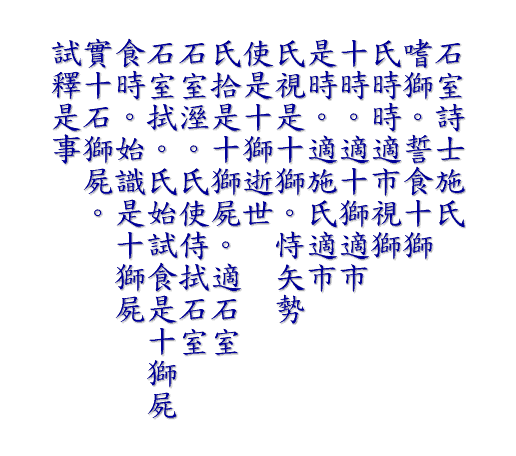
A perfectly sensible, albeit far-fetched, tale, but one that is incomprehensible in spoken Mandarin, and perhaps only just comprehensible in other dialects, like Cantonese. It is an elaborate tongue twister but also something more, for it is a window to the fact that you simply cannot hope to comprehend Chinese, nor even make substantial progress in (spoken) Mandarin, without a grasp of Chinese characters. Hence, if you seriously desire competence in Chinese, I suggest you begin by memorizing the 214 radicals and going from there. The initial myopic labor will only serve you well down the road. Zhao's tale is a vivid sign for how a student of Chinese can both love the byzantine richness of the language and yet also loathe the archaic inscrutability of its written dimensions. It has taken me nearly seven years of study to be able to read Zhao's tale in the original Chinese (since he employs a number of obscure words and also uses 文言文 wenyanwen), much less find it winsome, but I can't imagine having it explained to me, in a detailed manner, based only on a grasp of phonetic Mandarin.
Reading all this, you might wonder why I persist. I thought about it last night. At this point, Chinese is not a "challenge" as much as a hobby, and not a "hobby" as much as simply a habit. I don't really see how I can stop learning Chinese. It is a part of me, and knowing that gives me the patience to keep chipping away at it, perhaps even down to the hoary caverns of 古文 guwen and Sino-Tibetan etymology.
Top 1 Because the writing system is ridiculous
Top 2 Because the language doesn't have the common sense to use an alphabet
Top 3 Because even looking up a word in the dictionary is complicated
Top 4 Because there's classical Chinese (wenyanwen)
Top 5 Because there are too many romanization methods and they all suck
Top 6 Because tonal languages are weird
Top 7 Because there is culture difference
A reader on another friend's page quipped, "中文難學的第8個原因,因為他沒在中文國家長大 [The 8th reason he finds it hard to learn Chinese is he didn't grow up in a Chinese-speaking country]." Clever, but I think the matter runs deeper than that, as I explained to a friend who asked me about the article, thus:
Chinese is harder than many other languages only if the student chooses to be literate in it. Speaking most dialects of Chinese is as easy as learning... well, as easy as learning any other language by ear and mouth. But the fact is, it takes YEARS of CONSTANT study to be able to READ IN CHINESE, which is something I think no other language requires. I've been studying Japanese for nearly two months and I can already at least "say" what I see in a text. Give me another year of study and then a year in Japan and I guarantee I will be at a level in Japanese that it took me four years to reach in Chinese. Part of my 'advantage' with Japanese, of course, is that I can already 'understand' many Japanese characters (kanji) based on my knowledge of Chinese characters (漢字 Hanzi). BTW, I'm not bragging about my (projected) ability in Japanese, since after 4 years of Chinese, I still wasn't at a very high level of literacy. I've only gotten really competent in the past two years or so. Classical Chinese is, however, a nightmare, about which I will have more to say later.
I think I discovered the original source for most of the Facebook piece's ideas, which is an essay by David Moser (then at the University of Michigan Center for Chinese Studies), notoriously titled "Why Chinese Is So Damn Hard". Here are some choice lines:
Most Chinese people will cheerfully acknowledge that their language is hard, maybe the hardest on earth. ... Those who undertake to study the language for any other reason than the sheer joy of it will always be frustrated by the abysmal ratio of effort to effect. ... The beauty of the characters is indisputable, but as the Chinese people began to realize the importance of universal literacy, it became clear that these ideograms were sort of like bound feet -- some fetishists may have liked the way they looked, but they weren't too practical for daily use. ...
John DeFrancis, in his book The Chinese Language: Fact and Fantasy, reports that his Chinese colleagues estimate it takes seven to eight years for a Mandarin speaker to learn to read and write three thousand characters, whereas his French and Spanish colleagues estimate that students in their respective countries achieve comparable levels in half that time. ...
The problem of reading is often a touchy one for those in the China field. How many of us would dare stand up in front of a group of colleagues and read a randomly-selected passage out loud? Yet inferiority complexes or fear of losing face causes many teachers and students to become unwitting cooperators in a kind of conspiracy of silence wherein everyone pretends that after four years of Chinese the diligent student should be whizzing through anything from Confucius to Lu Xun, pausing only occasionally to look up some pesky low-frequency character (in their Chinese-Chinese dictionary, of course). Others, of course, are more honest about the difficulties. The other day one of my fellow graduate students, someone who has been studying Chinese for ten years or more, said to me "My research is really hampered by the fact that I still just can't read Chinese. It takes me hours to get through two or three pages, and I can't skim to save my life." This would be an astonishing admission for a tenth-year student of, say, French literature, yet it is a comment I hear all the time among my peers....
A teacher of mine once told me of a game he and a colleague would sometimes play: The contest involved pulling a book at random from the shelves of the Chinese section of the Asia Library and then seeing who could be the first to figure out what the book was about. ...
After about a year of studying French, I was able to read a lot. I went through the usual kinds of novels.... At the end of three years of learning Chinese, I hadn't yet read a single complete novel. I found it just too hard, impossibly slow, and unrewarding. Newspapers, too, were still too daunting. I couldn't read an article without looking up about every tenth character, and it was not uncommon for me to scan the front page of the People's Daily and not be able to completely decipher a single headline. ...
Chinese people I know who have studied English for a few years can usually write with a handwriting style that is almost indistinguishable from that of the average American. Very few Americans, on the other hand, ever learn to produce a natural calligraphic hand in Chinese that resembles anything but that of an awkward Chinese third-grader. If there were nothing else hard about Chinese, the task of learning to write characters alone would put it in the rogues' gallery of hard-to-learn languages. ...
If there is no obvious semantic clue in the radical, and no helpful phonetic component somewhere in the character, you're just sunk. And you're sunk whether your native language is Chinese or not; contrary to popular myth, Chinese people are not born with the ability to memorize arbitrary squiggles. In fact, one of the most gratifying experiences a foreign student of Chinese can have is to see a native speaker come up a complete blank when called upon to write the characters for some relatively common word. ...
This is such a gratifying experience, in fact, that I have actually kept a list of characters that I have observed Chinese people forget how to write. (A sick, obsessive activity, I know.) I have seen highly literate Chinese people forget how to write certain characters in common words like "tin can", "knee", "screwdriver", "snap" (as in "to snap one's fingers"), "elbow", "ginger", "cushion", "firecracker", and so on. And when I say "forget", I mean that they often cannot even put the first stroke down on the paper. Can you imagine a well-educated native English speaker totally forgetting how to write a word like "knee" or "tin can"? Or even a rarely-seen word like "scabbard" or "ragamuffin"? ...
I remember when I had been studying Chinese very hard for about three years, I had an interesting experience. One day I happened to find a Spanish-language newspaper sitting on a seat next to me. I picked it up out of curiosity. "Hmm," I thought to myself. "I've never studied Spanish in my life. I wonder how much of this I can understand." At random I picked a short article about an airplane crash and started to read. I found I could basically glean, with some guesswork, most of the information from the article. The crash took place near Los Angeles. 186 people were killed. There were no survivors. The plane crashed just one minute after take-off. There was nothing on the flight recorder to indicate a critical situation, and the tower was unaware of any emergency. The plane had just been serviced three days before and no mechanical problems had been found. And so on. After finishing the article I had a sudden discouraging realization: Having never studied a day of Spanish, I could read a Spanish newspaper more easily than I could a Chinese newspaper after more than three years of studying Chinese. ...
One of the most unreasonably difficult things about learning Chinese is that merely learning how to look up a word in the dictionary is about the equivalent of an entire semester of secretarial school. ...
In Chinese there are spaces between characters, but it takes quite a lot of knowledge of the language and often some genuine sleuth work to tell where word boundaries lie; thus it's often trial and error to look up a word. It would be as if English were written thus:
"FEAR LESS LY OUT SPOKE N BUT SOME WHAT HUMOR LESS NEW ENG LAND BORN LEAD ACT OR GEORGE MICHAEL SON EX PRESS ED OUT RAGE TO DAY AT THE STALE MATE BE TWEEN MAN AGE MENT AND THE ACT OR 'S UNION BE CAUSE THE STAND OFF HAD SET BACK THE TIME TABLE FOR PRO DUC TION OF HIS PLAY, A ONE MAN SHOW CASE THAT WAS HIS FIRST RUN A WAY BROAD WAY BOX OFFICE SMASH HIT. "THE FIRST A MEND MENT IS AT IS SUE" HE PRO CLAIM ED. "FOR A CENS OR OR AN EDIT OR TO EDIT OR OTHER WISE BLUE PENCIL QUESTION ABLE DIA LOG JUST TO KOW TOW TO RIGHT WING BORN AGAIN BIBLE THUMP ING FRUIT CAKE S IS A DOWN RIGHT DIS GRACE." ...
If you think that after three or four years of study you'll be breezing through Confucius and Mencius in the way third-year French students at a comparable level are reading Diderot and Voltaire, you're sadly mistaken. There are some westerners who can comfortably read classical Chinese, but most of them have a lot of gray hair or at least tenure. ... It's truly embarrassing to be out at a Chinese restaurant, and someone asks you to translate some characters on a wall hanging. "Hey, you speak Chinese. What does this scroll say?" You look up and see that the characters are written in wenyan, and in incomprehensible "grass-style" calligraphy to boot. It might as well be an EKG readout of a dying heart patient.
Whereas modern Mandarin is merely perversely hard, classical Chinese is deliberately impossible. Here's a secret that sinologists won't tell you: A passage in classical Chinese can be understood only if you already know what the passage says in the first place. This is because classical Chinese really consists of several centuries of esoteric anecdotes and in-jokes written in a kind of terse, miserly code for dissemination among a small, elite group of intellectually-inbred bookworms who already knew the whole literature backwards and forwards, anyway. An uninitiated westerner can no more be expected to understand such writing than Confucius himself, if transported to the present, could understand the entries in the "personal" section of the classified ads that say things like: "Hndsm. SWGM, 24, 160, sks BGM or WGM for gentle S&M, mod. bndg., some lthr., twosm or threesm ok, have own equip., wheels, 988-8752 lv. mssg. on ans. mach., no weirdos please." ...
But where the real difficulty comes in is when you start to really use Chinese to express yourself. You suddenly find yourself straitjacketed -- when you say the sentence with the intonation that feels natural, the tones come out all wrong. For example, if you wish say something like "Hey, that's my water glass you're drinking out of!", and you follow your intonational instincts -- that is, to put a distinct falling tone on the first character of the word for "my" -- you will have said a kind of gibberish that may or may not be understood. ...
Those who have tackled other difficult languages have their own litany of horror stories, I'm sure. But I still feel reasonably confident in asserting that, for an average American, Chinese is significantly harder to learn than any of the other thirty or so major world languages that are usually studied formally at the university level (though Japanese in many ways comes close). Not too interesting for linguists, maybe, but something to consider if you've decided to better yourself by learning a foreign language, and you're thinking "Gee, Chinese looks kinda neat." ...
How much harder is Chinese? Again, I'll use French as my canonical "easy language". This is a very rough and intuitive estimate, but I would say that it takes about three times as long to reach a level of comfortable fluency in speaking, reading, and writing Chinese as it takes to reach a comparable level in French. An average American could probably become reasonably fluent in two Romance languages in the time it would take them to reach the same level in Chinese. ...
Someone once said that learning Chinese is "a five-year lesson in humility". I used to think this meant that at the end of five years you will have mastered Chinese and learned humility along the way. However, now having studied Chinese for over six years, I have concluded that actually the phrase means that after five years your Chinese will still be abysmal, but at least you will have thoroughly learned humility.
There is still the awe-inspiring fact that Chinese people manage to learn their own language very well. Perhaps they are like the gradeschool kids that Baroque performance groups recruit to sing Bach cantatas. The story goes that someone in the audience, amazed at hearing such youthful cherubs flawlessly singing Bach's uncompromisingly difficult vocal music, asks the choir director, "But how are they able to perform such difficult music?"
"Shh -- not so loud!" says the director, "If you don't tell them it's difficult, they never know."
Suffice to say that much--very much--of what Moser describes resonates deeply with my own experience. I will never forget the time I asked a Taiwanese colleague how to write "sock" and how she couldn't remember... and how she asked her mother how to write it... and how her mother likewise could not begin to write it. Sock! Nor shall I forget the early despair I felt at flipping through a Bible or a dictionary and not even being able to find a page number quickly, since I still was not totally fluent in Chinese numbers. Nor should I ever forget the slow but real shock I felt one day, about three years ago, when I realized I had spent my first three years in Taiwan virtually completely illiterate on the streets. By then I could read nearly everything I passed on my scooter or on foot, but again, for three years I had been basically illiterate in the country in which I lived and worked as a teacher and as a part-time missionary. And the truth is, the vast majority of foreigners living here are just as profoundly illiterate, sometimes even after a couple decades.
Now, all those woes are mostly past me--these days I earn money on the side by making Chinese-to-English translations, and I'm learning Japanese with Chinese textbooks--but the fact is, there are days I wonder just how many Chineses there are in Chinese and if having learned however 'many' Chineses I've learned realistically equips me for what's around the corner. Most computers in Taiwan have Yahoo.com.tw as their default home page, so when I open IE or Mozilla, I have a brief glimpse at the headlines. Even now, I find I've only got about a 60% success rate of "cracking" the headline even just for "the main idea." I've been told this is because much of the Yahoo News comes out of Hong Kong, and therefore uses a different style of Chinese, but this 'reassurance' only underscores the problem: for all the Chinese I've learned, have I really learned the "right" Chinese? It's no less common a problem when I watch TV news over dinner or waiting in a clinic. I can watch a two/ or three-minute story, which of course has spoken interviews and graphic visual aids, and yet I might still have no idea what the story is really saying.
The good news is that I have accumulated so many characters at this point that, if I encounter an unknown word, I can, often but not always, make a good guess at both how to pronounce the word and what it might basically mean. But again, I'm just guessing enough to hope to be able to look it up more easily when I get a chance. If you've never studied Chinese, you might not grasp why Moser (and I and others) make so much of the "dictionary problem." In 1986 the Sinologist Victor Mair wrote an essay [PDF LINK] about the need for phonetically arranged Chinese dictionaries. "It is a source of continual regret and embarrassment," Mair confesses,
that, in general, my colleagues in Chinese studies consult their dictionaries far less frequently than do those in other fields of area studies. ...
Incredibly, many Chinese scholars with advanced degrees do not even know how to locate items in supposedly standard reference works or do so only with the greatest reluctance and deliberation. For those who do make the effort, the number of hours wasted in looking up words in Chinese dictionaries and other reference tools is absolutely staggering. ...
It is generally acknowledged that a passive command of about 5,500 characters is sufficient for reading the overwhelming majority of literary texts. ...
Even the most highly literate Chinese scholars can almost never recognize more than 10,000 characters and the person who can accurately produce as many as 5,000 is exceedingly rare. ...
For someone who has been actively involved in Chinese studies over a period of ten or fifteen years, the process of looking up a word (let us say t'ing-tuan)in his battery of Chinese dictionaries goes something like this. As he stares fixedly at the graph t'ing, he cannot be totally sure whether the radical is "ear", "ten", "eye" on its side or maybe "net", "one", "heart", or "jade". He knows that the graph basically means "hear" so by all rights it should be listed under "ear". But he has been burned too many times before. ... Although his insecurity is excusable, he feels a little bit guilty about not looking under "ear" and has an impulse to do so but his eyes begin to glaze over as he contemplates all of the residual strokes he would have to count. Supposing he were to miss one?
Mair goes on for several more lines recounting how he jumps from one lexicon to the next trying to find what he dimly recalls is a defunct legal term. The problem Mair mentions is that of "radicals." Radicals are the 214 components of all Chinese words which, loosely, express the "logical" type of word it is [LINK]. Some of the more famous and lucid radicals are the heart, hand, water, wood, mouth, and fire radicals, which, respectively, crop up in words having to do with intentions/feelings, change/action, moisture/fluidity/motion, wood/construction/tools, speech, and energy/cooking. Here are some examples:
意 yi4 - meaning or will
推 tui - push
流 liu2 - flow, current
森 sen - wooded (and of course 森林 senlin2 tree forest)
烧 燒 shao - burn
吗 嗎 ma - question particle
After enough time you simply learn how to spot the radical (look at the left, top, and bottom of the character, and occasionally the right), so I do find Mair's anecdote a bit over-the-top. All the same, some words break the radical rules and go by a rogue radical, so you might just have to consult an index listed according to total number of strokes. Moreover, sometimes the word has no apparent "logical" connection to its radical, so the radical is like a "false cognate" in terms of remembering it. Even once you pinpoint the radical, you must then find it based on the remaining strokes in the character. In 意 you must flip to the heart-radical section, about a third of the pages in, and then to the section of heart-words with 9 additional strokes (here due to the five strokes in 立 and the four strokes in 日 above 心). Then, of course, you must note if the character is spoken in a variant way (known as the loathsome phenomenon of "broken-sound words").
Anyway, eventually you just submit and get used to the, ahem, radical problem in Chinese. But another problem lurks. Maybe your dictionaries of choice don't have the word you need. Maybe it's too obscure, or a variant form. Admittedly, once you find a couple solid dictionaries, after years of sifting and practice, this is only a frequent problem at very high levels of study and in attempting to learn classical Chinese (which is why Mair, a professional Sinologist, encounters the problem so often). Chinese simply has too many words which appear too rarely to be both clear to most (even native) readers and easily located in most dictionaries. As far as I know, the regnant 214-radical classification system was invented by the Kangxi Dictionary [Wiki LINK], published in 1716. I have also read that, aside from being riddled with errors, and having never been revised and reissued in three centuries, two-thirds of the Kangxi Zidian are now defunct. So much for being a useful reference work.
The radical that happens to be highlighted in red is nuu3, the "female" radical. See how she curtsies?
As I mentioned above, I have recently taken up the gauntlet (again?) of trying to make sense of classical, or literary, Chinese (文言文 wenyanwen). Ever after just a few days, however, I must admit I find the task perhaps decisively discouraging. I honestly don't know if, for now anyway, I care enough about "the Chinese classics" in "the original Chinese" to really attain competence in classical Chinese. Nevertheless, I should mention a distinction between 古文 guwen and 文言文 wenyanwen. The former is "ancient Chinese," as found in The Book of Odes, Laozi's Daodejing, the Analects of Confucius, and so on. The latter refers more to the compact, densely allusive style of Chinese which developed from ancient Chinese and which was commonly used into the 20th century. I am committed--like a mental patient?--to learning Chinese for the rest of my life, so I realize my grasp of 文言文 wenyanwen will improve gradually the more Chinese I read generally. SO I am heartened to realize learning 文言文 wenyanwen is mostly a matter of attaining a higher level of stylistic competence, not that of trudging through a vast, and vastly arcane, underworld of ancient Chinese civilization as found in 古文 guwen. As for 古文 guwen, I'm not decided yet if I want to be able to read ancient Chinese well enough "on my own," or if reading explanations and annotations in Mandarin 'translation' will suffice. I also have to admit, despite my intensely autodidactic character, that 古文 guwen might be the one aspect of Chinese for which I absolutely require a teacher and regular courses.
Let me give you a taste of 古文 guwen and you might see why it is so daunting. At a used bookstore the other day, I was looking for books about ancient Chinese grammar, or just a basic guidebook to 文言文 wenyanwen. I found a historical grammar of Chinese, which is appealing in its own dry, laborious way, but I also came upon a few old sheets of printed paper inside another book. (This sort of clandestine break is why bibliophiles love used bookstores.) They were bound like a leaflet but were pages 9–18 from an unknown book. I found no hint of a title or author's name, but the chapter is titled "怎麼提高古文斷句能力 (How to Raise Your Ability to Parse Ancient Chinese Sentences)". The ability to parse––or literally 斷 'break'––古文 guwen is known as 古文斷句 (gu3wen2 duan4ju4) and I will refer to it as 斷句 duanju.
Our unknown author, whom I shall affectionately call Gao Wen Li, says, "斷句能力是閱讀古書的基本功 [The ability to parse sentences is fundamental in reading ancient texts]." The problem with 古文 guwen, Gao explains, is that it lacks punctuation or very clear signs of where one string of words begins and another begins (rather like ancient Latin notoriously has no spaces between words). He admits this is a common obstacle for young readers, but reminds us that the young already 斷句 duanju when they recite some of the most famous poems from their youngest schooling. For example, Li Bai's "Night Thoughts" (夜思 [LINK for more!]) begins 窗前明月光, and is parsed as follows: 窗前•明月光. Famously, it means, "Light seen before the window," and segues into Li Bai's nostalgia for his home. The point is that only by breaking it between 前 and 明 (which means it is read with a pause after 前 [which is, of course, cutely ironic if you understand Chinese]), can we make any real sense of the string of characters. So, Gao is saying, while 斷句 duanju is difficult, even children can do it.
A couple pages later, however, Gao admits there can be valid disagreements about 斷句 duanju, even among qualified readers. He cites a line from the Historical Records 史記: 項籍少時學書不成去學劍又不成. Gao then notes how the China Bookstore's edition of the Historical Records parses the sentence like so: 項籍少時•學書不成•去學劍•又不成, whereas the edition published by Beijing University parses it differently, thus: 項籍少時•學書不成•去;學劍•又不成. (I will not waste my time or yours with a 'serious' attempt to translate this, but I think the gist is that if little time is given to the study of books, the study of war will also suffer. Or maybe it means that if things are arranged poorly, one will not grow through academic study, and neither will martial training help one.) This comparison is followed by a string of questions, about how the words were used in ancient time and so forth. Gao then provides a longer citation, this time from 莊子 Zhuangzi, and a detailed analysis of how to parse it as he does, none of which I will provide here.
However, on page 17 Gao provides one final quotation, and a parsing analysis, which I will reproduce, for no other reason than that it vividly displays how tragicomically recondite 古文 guwen can be. In a chapter of 孟子 Mengzi, we read the following:
曰王之好樂甚則齊其庶幾乎今之樂猶古之樂也曰可得聞與曰讀樂樂與人樂樂孰樂曰不若與人曰曰與少樂樂與眾樂樂孰樂曰不若與眾。
[Personal anecdote: It just took me nearly ten minutes to enter 孰 the first time, since I couldn't guess its proper phoneme (shu2, it turns out), couldn't decide which radical under which to find it, and couldn't pick it out from a long list of other 11-stroke characters at this good online dictionary. My sympathies go out to Mair, and his to me, in a fresh way. {I have asked a number of native speakers about 孰 and they are also consistently beguiled by or diffident about its radical. Cue petty sense of vindication!}]
Gao notes how within only 50 or so characters, 樂 is used 30 times. He then ever so kindly explains that, as nearly all students of Chinese know, this 樂 is a dreaded 破音字 "broken-sound word", read either as yue4 or le4, and means either music or happy, respectively. He then explains that this dialogue which Mengzi is having with the king, is about whether listening to music 樂 by oneself makes for a greater or lesser happiness 樂 than listening to it with others. Here is how the dialogue is parsed on a webpage I happened to find via Google:
曰 :「王 之 好 樂 甚 , 則 齊 其 庶 幾 乎 ! 今 之 樂 猶 古 之 樂 也 .」 曰 :「可 得 聞 與 ?」 曰 :「獨 樂 樂 , 與 人 樂 樂 , 孰 樂 ?」 曰 :「 不 若 與 人 .」 曰 :「與 少 樂 樂 , 與 眾 樂 樂 , 孰 樂 ?」 曰 :「不 若 與 眾 .」
This is still all too clever and arcane for the beginner, but a good parsing makes it much less rebarbative. Well, a little less rebarbative.
On the bright side, one thing motivating me to really "crack" 文言文 wenyanwen is that ancient Japanese (known as kanbun 漢文 or "Han/Chinese writing") just is 文言文 wenyanwen. So perhaps my progress into Japanese and my grudging descent into 古文 guwen will reinforce each other and bring me to a happy middle position... about 30 years from now. In the meanwhile, I have discovered a wonderful blog discussing one man's progress in learning 古文 guwen, "Nothing Undone," and do intend to keep up with it as a slow but steady way of absorbing 古文 guwen at my own pace. (Lest I forget, I should add that the Kangxi Zidian is written in 文言文 wenyanwen, so even its explanations of obscure words are themselves grammatically obtuse to modern readers.)
Speaking of Japanese, let me cite Moser again to clarify why I think Japanese is so much easier, in terms of literacy, than Chinese. In a footnote to his essay, Moser says,
I'm aware that much of what I've said above applies to Japanese as well, but it seems clear that the burden placed on a learner of Japanese is much lighter because (a) the number of Chinese characters used in Japanese is "only" about 2,000 -- fewer by a factor of two or three compared to the number needed by the average literate Chinese reader; and (b) the Japanese have phonetic syllabaries (the hiragana and katakana characters), which are nearly 100% phonetically reliable and are in many ways easier to master than chaotic English orthography is.
It took me a few weeks to master hiragana and katakana, and this means I can sound out all words in basic Japanese texts which provide furigana (i.e., hiragana or katakana above or beside the character, as in children's books and some ads). It also means I can actually read and write actual Japanese words and grammatical structures based on learning them by ear-and-mouth. I can certainly enjoy the same benefit of phonetic "cheats" in Chinese children's books and the like (here in Taiwan they use Zhuyin Fuhao, normally inserted horizontally in tiny script next to each character), but for the most part writing what I want to say in Zhuyin would quickly be a dead end, since Mandarin has too many homophones, as I shall show presently. It's an open secret that the rise of computers has led to major declines in the written ability of native Chinese speakers in this generation. Not only will high-school and university students in Taiwan commonly resort to simplified (PRC) characters when the traditional character is to ornate, but also students in both Taiwan and China will often just write notes at high speed in Pinyin or Zhuyin, perhaps even in English, since keeping up with a spoken lecture whilst writing characters is more trouble than most people want. As Moser notes, Chinese is not just "difficult for foreigners"; it's just difficult.
 (This level of nagging difficulty holds for Chinese and Japanese typewriters as well, as this humorous how-to explains. [Wiki LINK to Chinese typewriter and LINK to Japanese typewriter.] Here's another quick expose of the Chinese typewriter at Wired and a lush post about Japanese typewriters.)
Let me show you an "artifact" that might capture the paradoxical love-hate relationship Sinophiles have with Chinese. The following essay-story was written by 趙元任 Zhao Yuan Ren (1892-1982), a language prodigy and Chinese-American sociolinguist. It is titled "The Chronicle of the Lion-Eating Poet named Shi [in the Stone Den]" and is written 施氏食獅史 [施氏食狮史] in Chinese (traditional and [simplified] characters). (Wiki LINK] Nothing about it is so terribly remarkable--except, I guess, the idea of a lion-eating poet in a cave--until you hear it read aloud or, in this venue, see its phonetic transcription (in Hanyu Pinyin): "Shī Shì shí shī shǐ". That's right: all the words in the title are pronounced as common fricatives of varying tones. And it doesn't stop there. Here is the whole of the tale in Hanyu Pinyin:
Shíshì shīshì Shī Shì, shì shī, shì shí shí shī.
Shì shíshí shì shì shì shī.
Shí shí, shì shí shī shì shì.
Shì shí, shì Shī Shì shì shì.
Shì shì shì shí shī, shì shǐ shì, shǐ shì shí shī shìshì.
Shì shí shì shí shī shī, shì shíshì.
Shíshì shī, Shì shǐ shì shì shíshì.
Shíshì shì, Shì shǐ shì shí shì shí shī.
Shí shí, shǐ shí shì shí shī, shí shí shí shī shī.
Shì shì shì shì.
Here are the characters:
石室詩士施氏,嗜獅,誓食十獅。
氏時時適市視獅。
十時,適十獅適市。
是時,適施氏適市。
氏視是十獅,恃矢勢,使是十獅逝世。
氏拾是十獅屍,適石室。
石室濕,氏使侍拭石室。
石室拭,氏始試食是十獅。
食時,始識是十獅,實十石獅屍。
試釋是事。
You can hear it read aloud at Youtube here or here. Below is a .gif of the tale, followed by the web author's own translation.
A poet by the name of Shih Shih living in a stone den was fond of lions. As he had taken an oath to eat ten lions, he went out to the market every day at ten o'clock in order to look for lions. It was at the time when all of a sudden ten lions came to the market and also Shih Shih went to the market at once realizing [sic] these ten lions. Relying on his (bow and) arrows, he caused these ten lions to pass away. Shih picked up the corpses of these ten lions, and as he went to the stone den, the stone chamber was damp. Shih had the stone den wiped by his servant. As the stone den was cleaned, it was the time [sic] that Shih began trying to eat the meal of these ten lions' corpses and he began to realize that these ten dead lions in fact were ten stone lions' corpses and he tried to get rid of this matter.
A perfectly sensible, albeit far-fetched, tale, but one that is incomprehensible in spoken Mandarin, and perhaps only just comprehensible in other dialects, like Cantonese. It is an elaborate tongue twister but also something more, for it is a window to the fact that you simply cannot hope to comprehend Chinese, nor even make substantial progress in (spoken) Mandarin, without a grasp of Chinese characters. Hence, if you seriously desire competence in Chinese, I suggest you begin by memorizing the 214 radicals and going from there. The initial myopic labor will only serve you well down the road. Zhao's tale is a vivid sign for how a student of Chinese can both love the byzantine richness of the language and yet also loathe the archaic inscrutability of its written dimensions. It has taken me nearly seven years of study to be able to read Zhao's tale in the original Chinese (since he employs a number of obscure words and also uses 文言文 wenyanwen), much less find it winsome, but I can't imagine having it explained to me, in a detailed manner, based only on a grasp of phonetic Mandarin.
Reading all this, you might wonder why I persist. I thought about it last night. At this point, Chinese is not a "challenge" as much as a hobby, and not a "hobby" as much as simply a habit. I don't really see how I can stop learning Chinese. It is a part of me, and knowing that gives me the patience to keep chipping away at it, perhaps even down to the hoary caverns of 古文 guwen and Sino-Tibetan etymology.
Monday, January 25, 2010
Caveat emptor…
AP Enterprise: US buyers must beware in China (AP, 16 Jan., 2010)
It's too bad this article is so even-handed. Otherwise, it's just too tempting and too much fun to take what comes out of China as intentionally sub-par. Poison their children with defective toys! Kill their pets with noxious food! Undermine their work force with cheap labor! Sigh. I may not have been a Cold War baby, but I like to think of myself as a Cold War man.
China's latest quality controversy erupted this week after an investigation by The Associated Press found that 12 of 103 pieces of Chinese-made children's jewelry bought in U.S. stores contained at least 10 percent cadmium, some in the 80-90 percent range. Two others were found to have less than 10 percent in laboratory tests and the rest had none. …
American businessman Rick Goodwin, who has worked in China for 20 years, said the country has plenty of unscrupulous factories. But he said a major problem was foreign buyers who, because of greed, naivete or ignorance, approach China like it's just a discount shopping center. …
One thing that frequently happens in China is that factory owners will bid extremely low — even to the point where they have no profit — just to win an order. Once they've got the business, they search for ways to cut corners so they can widen their profit margin and recover what they lost with their lowball bid. They might switch to cheaper lead paint or buy inexpensive metal containing cadmium. This is called "quality fade."
It's too bad this article is so even-handed. Otherwise, it's just too tempting and too much fun to take what comes out of China as intentionally sub-par. Poison their children with defective toys! Kill their pets with noxious food! Undermine their work force with cheap labor! Sigh. I may not have been a Cold War baby, but I like to think of myself as a Cold War man.
Labels:
Chinese,
Culture and News
Subscribe to:
Posts (Atom)