Showing posts with label Memoirs and Friends. Show all posts

Wednesday, March 28, 2012

A dialogue, sort of, about gay marriage… 

2 comment(s)
Some background:

I'm very new to Tweeter. I "took it up" (ahem) a couple weeks ago, partially because I got a new "smart" mobile phone recently, and partially because I've heard Twitter is the more "professional" social medium. (I think LinkedIn really is the professional social medium to use, but I've found Twitter to be much less consuming, and much more focused, than Facebook.) I suspect it's not a coincidence that the core of the word "twitter" is "witty". In fact, I might say I've found my " twiche ". Probably my favorite aspect of Twitter is that it forces me to be concise. I can write more by outlinking to TwitLonger, but I like the challenge of trying to make my point in 140 characters. As Goethe said, "Der Meister zeigt sich in der Beschränkungen."

So, the following dialogue is a revised reconstruction of an actual dialogue I've been having on Twitter the past week or two.

Full disclosure: my interlocutor's moniker is nothing less inflammatory than "ifollowHATE". He or she chose to follow me because I have either retweeted comments against "gay marriage", or voiced my own objections to it.


Codgitator: [Upon discovering that I was being followed by "ifollowHATE"] So if you hate hate, do you follow yourself? Or hate yourself? Or just hate others for differing from you?

Some Tweeter: No, I hate the lies that people tell to harm others. That is hate. It is sinful.

C: You mean lies about the Catholic Church's authentic teachings? I assume you follow me because I oppose "gay marriage".

S: We are talking about civil laws, not the Catholic teachings. The organizations that you follow advocate for laws that harm others.

C: By tarring nonconformity "hate" I feel you cheapen the language and derail dialogue -- the prerogative of demagogues.

S: By supporting banning gays from marriage, I feel you cause harm to them and derail their rights.

C: I get your angle. The question is whether marriage is a right in service of individuals or in service of the common good. Law forbids consanguinous, underage, and bigamous marriage. Law is for a common future, not for special interests.

S: Not special interests. The same right that everyone else enjoys. The right to marry the one person that you love.

C: Why limit marriage to 1+1? Awful prejudice. Why not 1+1+1? 1+1+/-1? 1+x+y? Is the point of law only point to protect "love feelings"? Defending gay marriage as a civil right begs the question. What is the point of marriage? To what do gays want access by winning "marriage"?

S: What important government purpose is accomplished by banning gay couples from Civil Marriage? Do you have a reason for limiting marriage to all those people, or is it just prejudice against them?

C: Any definition of marriage imposes limits, as I've shown in your monogamy bias. A definition… by definition… is limiting. The key is to legislate to the long-term good of marriage.

S: What important governmental purpose is furthered by banning gay couples from marriage? Just one.

C: If legal limitations are implicitly unjust, what's the point of any government marriage laws? What is the purpose of marriage? What does "gay" add to it? Indeed, why can't siblings marry, if they're as deeply as in love as any gay or straight couple? Making that kind of bond "marriage" undermines the common benefit of marriage over generations.

S: What good does it do to ban gay people from marriage, then? Give your reason for the line that you have drawn.

C: First, marriage is no more a right than hunting or driving or bartending is, hence we need licenses for them. It's not in the interest of the law to widen the licensing gate for marriage [or should I say, lower the bar?], and thus lower the long-term stability of marriage as a pillar of society. Gay marriage adds nothing to the long-term security of marriage (to put it mildly), and bars gays from no more than enjoying the feeling of having Sneetch-belly-stars of their own. No bloodlines can be formed in gay marriage, so it's not marriage. Marriage is the social analogue of biological continuity.

Second, asking why government can "ban" gays from marriage is not only inflammatory but also begs the question. It has never been the case that a loophole was open for gays to marriage, until one day some conservative cabal decided to "ban" the trickle of gays who were finally taking advantage of their "right" to the loophole. What has happened is that one group has stormed the courts to jam a loophole into marriage law for their own special interests. No-fault divorce advocates did the same decades ago, to the grave detriment of marriage. Why add insult to injury with another judicial revamping of nature? Gay people aren't being banned from loving and living and dying with whomever they wish. They are being denied a license on the grounds that their lifestyle would adds nothing to the actual, long-term practice of marriage as a biological and social reality. Not giving a motor license to a blind man is radically different from banning him from traveling at all, by other means, such as private or public transit. As pro-queer journalist Victoria Brownworth has stated, "[A]llowing same‐sex couples to marry will weaken the institution of marriage."

S: Prove it.

C: The point of the quotation is precisely that Brownworth is pro-gay-marriage.

S: I know who she is. I also know the entire quote. As I said. Prove it. It should be easy.

C: Here's my basic problem: you deny that marriage has any essential features–– you deny there is any real nature of marriage beyond how we speak of it–– yet you want gays to enjoy this chimerical "marriage". But what is marriage? If marriage is just a social convention, a purely legal custom, then what is it gays could possibly gain by "marriage"? Any essential features you propose for marriage–– gay, straight, or otherwise–– must be based in something above the law. The problem is that, for whichever features you propose as maritally non-negotiable, there is a special interest group which would brand those features as narrowly prejudiced and as merely legal customs. (If you were lucky, you'd even get a boob from their camp to follow you via a popular social medium.) Failing that, if you admit marriage is just a word, just a social game, then why should thee be any marriage law at all? There cannot be laws about pure fictions. You can't have it both ways. Either marriage really is of an unalterable nature, which must be explained and obeyed by all, or it is just a wax nose, and law is irrelevant to the satisfaction of gay intimacy.

Fourth, I'm not sure I should bother giving you reasoned answers, since your moniker implies the only reason I could have for opposing gay (as well as bigamous, underage, incestuous, fraudulent, necrophiliac, etc.) marriage, is because I "HATE". Yes. That's it. How insightful of you. Here's to an America where the only choices are doe-eyed social conformity or blind "hate". If you honestly think having principled objections to a radical, partisan innovation just is "hatred", you are a boob and really ought to follow yourself.

S: So… owning a gun isn't a right, because it requires a license?
C: Even American toddlers lack a right to guns without a license. Call it inflammatory or not, you put the cart before the horse.

S: In all that, you still didn't answer the question. What is the important governmental purpose accomplished by banning gay marriage? "We will be more American on the day after we permit gay marriage than we were on the day before". That's one of your guys [Blankenhorn in Propostition 8 corss-examination].

C: I have said why it's not in the interest of the state to reinvent the wheel on marriage. Gay marriage is no more banned than unicorn chariot rides are: both are fictions. Government policy should aim to promote longterm good for the whole polity. Gay marriage (GM) merits no more government aid than bigamy.

Monday, March 19, 2012

Microcogditations from the front…

0 comment(s)
This humidity must be part of my penance the priest slipped in when I wasn't listening. Despite everything, Marcus Aurelius never had to deal with this weather!
#TropicalKickToTheHead #Stoicism


""Both [Paganism & Stoicism] were consistent, philosophical, and exalted... [but] the first leads logically to murder and the second to suicide. ... It is only the Mystic, the man who accepts the contradictions [of life], who can laugh and walk easily through the world." - GKC


Passing an ad for plastic surgery, asked wife if she wants that. Bugged eyes: "No. I'm beautiful."
#MyWifeRocks


The nail in the coffin for FTL Neutrinos: LINK.


I stand sideways in conversations so people realize I want to go, but doing so only seems to drag it out.
#YouDoItToYourself #Fail


I'm leery of writing his O'ness' name in conjunction with the HHS struggle, since doing so not only misses the point (i.e. it's bigger than him, if not bigger than his ego), but also risks making opposition to HHS qua "O____care" a political campaign, at which point religious opponents of HHS have overstepped the very bounds they're trying to protect.


@eckharttolle "Real love doesn't make you suffer. How could it?" By making you sacrifice, how about? Saying "I love you" even when you don't 'feel' it is just what validates your love: the difference between loving and being "in love".
#SacredHeart #Crucifixion


George Clooney arrested in Washington, D.C. "for protesting Sudan’s attacks on its Nuba people."
"How many more bodies until the Nuba mountains become the next Darfur?"


My friend wanted to let me be happy in my "new baby" bubble, filter bad news, but I kneel to a crucified peasant everyday: my bubble is… congenitally open.
#SacredHeart #Crucifixion


The duality of human fecundity (maker/medium, male/female, thought/act) finds unity in the absolute simplicity of God as all-wise Creator. Mary's virgin motherhood is but a portrait of the deeper mystery of God's virgin fatherhood. God as Spirit thus transcends and grounds sex. Atheism is ontological solipsism.
#AnalogiaEntis


It must never be forgotten that economy originally meant family budget.
#Distributism


Scientismatics want a final theory, a theory which would in principle be universally valid, and thus physically deductive, yet they reject religion i.a. because theistic claims are "not in principle" falsifiable. Huh?
#scientism #CultofGnu

Friday, February 3, 2012

A conversation I recently had at work…

0 comment(s)
There I was, minding my own business, finishing yet another reading of the epistle of James, waiting for the students to arrive, when suddenly my co-worker blurted out, "The Bible?"

"Yes," I said, "that old thing."

"Have you read the whole thing?"

"Yes."

Unlike you, I'd wager.

"Why are you reading it? Just to… re-fresh… your… or…?"

"Yes, I'm one of those. I'm a Catholic."

"Still? Oh."

"I wasn't always Catholic. I was raised Presbyterian, but about five years ago, I entered the Church. I take it you are… interested in the Bible?"

By interested, of course, I mean titillated by your own sophomoric disdain for anything older or bigger than you.

"You mean the official Bible, or the ones that were repressed?"


"Ah, yes, I'm familiar with what you mean, but no, I'm reading the orthodox Bible, not the Gospel or Judas or Thomas or anything like that. Do you study religious history?"

As in, do you imbibe as much of the Huffington Post and Youtube clips as your leisure affords?

"Well, I was into history and soash at uni, so… yeah."

Soash!

"So, you like religious history?"

"I like… facts. I mean, not that there are any."

Well, that's a relief. Here I thought you were challenging my faith based on damning facts about the Bible. Good thing there are no facts with which I must contend, aside, I suppose, from the fact of your visceral loathing for Christian tradition and the very idea of truth.

"Ahh. Okay. Right."

"I'm interested in how society… how social ideas can… influence or shape people's actions. Like Scientology, wow! I saw this amazing documentary on BBC last night about Scientology."

Sweet lamb, if only you realized how the "social determinist" argument cuts both ways. If you turn your read, just so, in just the right light, I can only faintly detect the thread of silver running from Dawkins' blog to the ring in your nose.

"Oh, BBC, they're pretty good."

"Yeah, but, well, everybody's got a bias."

Fortunately, everyone but you, right?

"What are you gonna do?"

"I try not to think about it all. I just want to be happy."

Quite.

Books I've read in the last six months or so…

1 comment(s)
As you may know, I keep a running tab on my "mental diet" (books and movies), but decided to share my latest explorations. Has anyone here read any of these books and have any opinions to offer?

If you visit my log, you'll notice I'm still (still!) reading a few other books, which means I've been reading about two books a week lately, so, roughly (in theory), I read 300 books last year. Here's to another 300 this year! The interesting thing is, that's more than twice as much as I used to read in high school and college per annum. If only I could get back to writing as much as I used to then, as well.

Schopenhauer: A Very Short Introduction (2002) by Christopher Janaway
An Introduction to Philosophical Logic (1982; 1st ed.) by A. C. Grayling
Self, Logic, and Figurative Thinking (2009) by Harwood Fisher
The Development of Logic (1962) by William Kneale & Martha Kneale
Thomas Aquinas: Selected Writings (1998) (ed.) Ralph McInerny
• God Is a Bullet by Boston Teran
The Blue Hour by T. Jefferson Parker
Under the Dome by Stephen King
Duma Key by Stephen King
The Dead Zone by Stephen King
The Amazing Adventures of Kavalier and Clay by Michael Chabon
The Terror by Dan Simmons
The Talisman by Stephen King & Peter Straub
Point Omega by Don DeLillo
Wise Blood by Flannery O'Connor
The Yiddish Policeman's Union by Michael Chabon
The Nature of the Mind by Peter Carruthers
Personal Identity by Harold Noonan
Theory and Truth by Lawrence Sklar
Philosophical Logic by John P. Burgess
Philosophy of Logic by W.V.O. Quine
From a Logical Point of View by W.V.O. Quine
Everywhere and Everywhen by Nick Huggett
Thinking about Physics by Roger G. Newton
Real Essentialism by David Oderberg
Why Marx Was Right (2011) by Terry Eagleton
Logic (1985) by Juan Jose Sanguineti
Nominalism and Realism – Volume 1 of Universals and Scientific Realism (1980) by D. M. Armstrong
A Theory of Universals – Volume 2 of Universals and Scientific Realism (1980) by D. M. Armstrong
Couplehood by Paul Reiser
What Matters? Economics for a Renewed Commonwealth by Wendell Berry
The Politically Incorrect Guide to Capitalism by Robert P. Murphy, Ph.D.
Toward a Truly Free Market: A Distributist Perspective on the Role of Government, Taxes, Health Care, Deficits, and More (2010) by John M. Médaille
Leibniz's Mill: A Challenge to Materialism (2011) by Charles Landesman
The Politically Incorrect Guide to Socialism by Kevin D. Williamson
In Defence of Global Capitalism (2001) by Johan Norberg
The "Poisoned Spring" of Economic Libertarianism –– Menger, Mises, Hayek, Rothbard: A Critique from Catholic Social Teaching of the 'Austrian School' of Economics (2011) by Angus Sibley
Micro (2012) by Michael Crichton w/ Richard Preston
The Case for Working with Your Hands, Or Why Office Work Is Bad for Us and Fixing Things Feels Good (2010) by Stephen Crawford
The Conscience of a Liberal (2009) by Paul Krugman
Free Lunch: Easily Digestible Economics, Served on a Plate (2003) by David Smith
The Mystery of Capital: Why Capitalism Triumphs in the West and Fails Everywhere Else (2000) by Hernando de Soto
Why Most Things Fail: Evolution, Extinction & Economics (2005) by Paul Ormerod
What's Wrong with the World (1910) by G.K. Chesterton
The Servile State (1912) by Hilaire Belloc
The Sun of Justice: An Essay on the Social Teaching of the Catholic Church (1938) by Harold Robbins
The Persistence of the Old Regime: Europe to the Great War ([1981] 2010 2nd ed.) by Arno J. Mayer

Thursday, February 2, 2012

We can't strike out on this one…

3 comment(s)
Conscience Protection

Bishops Vow to Fight Coercive HHS Mandate


Watch his video
&
take action today!

Call the U.S. Capitol switchboard at: 202-224-3121, or call your Members’ local offices.

Send an e-mail through NCHLA’s Grassroots Action Center at: HERE.


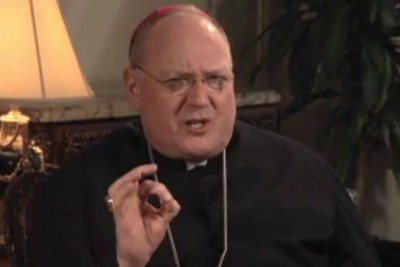
Cardinal-designate Timothy Dolan, president of the USCCB, sharply criticized the decision by the Obama administration in which it "ordered almost every employer and insurer in the country to provide sterilization and contraceptives, including some abortion-inducing drugs, in their health plans.... Never before has the federal government forced individuals and organizations to go out into the marketplace and buy a product that violates their conscience. This shouldn't happen in a land where free exercise of religion ranks first in the Bill of Rights."

Thursday, January 5, 2012

That isn't just bullshit…

0 comment(s)
Me: "The point of distributism is that capitalism must regulate-itself-or-be-regulated in a way that protects and promotes the very conditions which make capitalism possible. Labor is taken as a given in neoclassical economics, but labor is nothing more than laborers, who are nothing more than the sons and daughters of families. Therefore, the market must first respect families –– the market must not use families, it must consist in families."

My coworker: "Hm. That's the first thing I've heard that… takes away from capitalism… that isn't just bullshit."

Tuesday, December 27, 2011

Man in his entirety...

0 comment(s)
From Teacher to Farmer: Why I Went Back to the Land
Posted By Kevin Ford On November 11, 2011 8:54 AM
A little more than a year ago, I quit my job as a theology teacher at a Catholic high school to become a full-time organic farmer. I like to call myself a “Catholic farmer”, because I am striving to live out the Church’s teachings on marriage and the family, as well as Catholic social teaching, in my work and in the daily life of my family. I had been contemplating a return to the land for several years, and I finally opened myself to the grace needed to take such a leap of faith. I feel as though my story is a microcosm of the Catholic Land Movement as a whole. I doubt if any will follow exactly the same path, but hopefully some will end up on the land, working to restore Catholic culture, just as I did. After much prayer and discernment, I have narrowed my reasons for returning to the land to the following: restoring Catholic family life, bringing wholeness to our lives, regaining simplicity, and building Catholic community.

In our world today, nothing comes under attack more often than marriage and the family. In this modern assault, I felt it necessary to flee to the fields in order to provide an environment that is natural for family life, one where my children could flourish. City life with its “damnable conveniences” as Fr. McNabb, O.P., called them, is often a source of great temptation. The pagan temples and idols of today are not so clearly perceived, because they are often disguised in masks of pleasure, convenience, and materialism. To me, a return to the land marks a radical departure from the frivolity of modern city life as I seek to live a life that is meaningfully fruitful. Pope Benedict XVI has stated: “The rural family must regain its place at the heart of the social order.”(1) The rural family has traditionally been the backbone of healthy cultures. Never in history has the mass of humanity been concentrated in the cities as they are today. Pope Pius XII speaks very wisely of the benefits of rural life for families in his address to Italian farm laborers:
Your lives are rooted in the family...; consequently, they conform very closely to nature. In this fact lies your economic strength and your ability to withstand adversity in critical times ... [and] the importance of your contribution to the correct development of the private and public order of society. You are called upon for this reason to perform an indispensable function as source and defense of a stainless moral and religious life. For the land is a kind of nursery which supplies men, sound in soul and body, for all occupations, for the Church, and for the State.(2) 
... I sought a place for my family to live out its life in totality without the distractions that city life often brings..., way out in the country whose nights are lit by heavenly lights alone.

... As I taught theology to high school students, I would often find myself thinking about my own children and the difficulty I would have passing on the faith to them, simply because of how much time I must spend at school. I did not doubt the dignity of the teaching profession. However, I doubted the wisdom of our modern age that insists on men working separate from their families, and always seeking after a wage. ... I began to realize that the breakdown of the family could be traced to the implementation of the wage system. ... [T]he family didn’t start to fall apart when mothers left the home for the work place. Rather, the family’s disintegration began when fathers left the home and the land for the convenience of a city wage. 
... The etymology of the word husband was absolutely fascinating. Hus-Band literally means house-bound. When a man was married he became house bound. There in the home with his wife he would bring forth a family. There in the home he would work and provide for the family; everything was centered around the home. The home was not a place to return to after work, but rather it was the place of work, it was the center of life, and it was the stability that fostered healthy families. I realized that what I wanted was a life that was whole, one that had integrity. I wanted to live, work, and pray with my family all the time, not just in the evenings or when I was off work. I wanted to be a husband in the true sense of the word, and I wanted to be a father who was always there. Working towards a self-sufficient life on the land offers me the opportunity to truly be a father to my children. I can’t express in words how beautiful this has been.

The third reason I returned to the land was to regain simplicity. Reading Eric Brende’s book, Better Off: Flipping the Switch on Technology, profoundly impacted my views on modern technologically-saturated life. ... It is not that all machines are bad, but the scale to which technology has infiltrated our lives led me to take my family down a different path. Now we analyze our technology piece by piece and look carefully at its effects on family life. If it is truly more harmful to family life than helpful, then we simply don’t need it. Too often a machine has taken the place of meaningful human and family interaction. 
Dishwashers haven’t decreased the dish loads, but rather increased the sinks full of dishes and decreased important interaction between people, especially children, as they learn to work together. ... We find that with less technology, we suddenly have time for activities we previously couldn’t squeeze in. Without the time in front of the television, we find time to read together, sing and dance with the piano, or simply sit out back in the evenings and watch the chickens scratch about (chickens can be a source of great hilarity, believe it or not). This simplicity gets rid of excess distractions and leaves us with more time for one another.

The final reason I returned to the land was in hope of rebuilding Catholic rural community. ... Today Catholic communal life is gravely lacking. ... [My wife and I] sought a Catholic village. Starting something like this from scratch was simply out of the question. ... We are still seeking ways to build Catholic community wherever God leads us. It is a dream of ours that one day we will have many neighbors farming and doing their various crafts next door, but until then we will have to wait for the right door to open.

Our faith is sacramental, and therefore it is not meant to be only a spiritual reality. Catholicism with its sacraments corresponds to man in his entirety. We who are embodied souls need a faith that is both physical and spiritual. Thus we seek in some way to incarnate our Catholic life on the land and to share that life with others. ... 
Going back to the land has radically changed my life and my goals. It has transformed my way of thinking, and it daily encourages me to be a better man. By throwing myself into the hands of providence, I am forced to give my fiat or give up. ... Yet, I have never done anything so rewarding and at the same time so difficult. I hope many others will follow in my footsteps, and that one day we may have a countryside filled with Catholic smallholdings once again. Vivat Christus Rex!

Notes


(1) Message of his Holiness BENEDICT XVI to the Director General of the Food and Agriculture Organization (FAO) for the Celebration of World Food Day, from the Vatican, 16 October, 2006


(2) Speech delivered by His Holiness to the delegates at the Convention of the National Confederation of Farm Owner-Operators in Rome on November 15, 1946, #4.

Wednesday, November 30, 2011

This is where my head is...

0 comment(s)
Up with economy, down with chrematistics!

Below is the TED Talk for Open Source Ecology. Have a gander. It has me drooling.

The book that got my wheels spinning in this direction is Eric Brende's Better Off: Flipping the Switch on Technology. My recent posting of Matthew Crawford's essay on "the case for working with your hands" is also part of this impulse. Wendell Barry's new book What Matters? Economics for a Renewed Commonwealth is also good stuff.

My larger philosophical impulse is an increasing absorption with distributism, as my recent various quotations about economic matters should indicate. Distributism is often mocked for being impractical, but the Open Source Ecology shows how hollow that accusation is. I have been reading numerous posts at The Distributist Review and have a stack of books on economics and social equity ahead of me. I have long been skeptical of the ideology of overpopulation fear-mongering, and one aspect of the debate is hunger and economic equity. The problem with global population is not whether resources are adequate--they are!--but how the resources are distributed and tended by global peoples. It was not until recently, however, that I realized the direct link between my own standard-and-style of living and the problem of unjust economic distribution.

There is a lot of talk nowadays about redistribution, but I think that misses the point on two fronts. First, since America long ago ceased being a quasi-distributist polity, the redistribution many people want remains confined in the capitalistic strictures that distributism opposes. Second, distributism allows for economic prosperity and entrepreneurship--indeed, distributists believe a distributist economy is what grounds entrepreneurship in the first place!


Hence, distributism avoids the errors of socialism (i.e. negation of private property and absolute centralized regulation of property development) and avoids the errors of capitalism (i.e. the intrinsic centralization of capital apart from individual families' autonomy over their own property as a potentially total domain of "real value"). It is a central tenet of Catholic social teaching that the family is the nucleus of human society, and in so far as distributism puts families, as opposed to the state or consumers, first, puts me largely in the distributist camp.


In any event, perhaps being a husband and father-to-be has given me the focus and personal attachment to see how simply living and living simply are great sources of joy, and how I myself can live out our abiding Adamic call to stewardship of Creation.


Thursday, September 29, 2011

What you read is what you get…

0 comment(s)
…and other amusing anecdotes of late.

Earlier this week I was playing a grammar game in class, which involves three staircases represented on the board, which each team can ascend (to glory) or descend (to doom), and, further, which teams can push their opponents down. Three staircases is the best format, since two teams invariably gang up on the third team. Well, almost invariably. This week, I was simultaneously appalled and amused to see my seventh-grade students discovered game theory on their own! At some point, team A insisted on pushing team C up one step. I said they couldn't do that, but they were adamant. I was bemused, since vicious competition makes students focus better and try harder, but I let A bump C up. Two questions later, team C insisted on bumping team A up! Fortunately, the class was over soon, so their spirits weren't utterly sedated by their socialism. I caught one student, the original philanthropist, explaining to her teammates that she could tell team C was getting angry, so she wanted to make them feel better, not the least so that C wouldn't lash back at A. Fascinating.

This morning while driving to work, a man ahead of me was wearing a purple T-shirt with the word "STAGE" printed on the back in capital letters. The A, however, was printed without the middle horizontal bar, so all I saw was one form of the logical symbol for "empty set." That's what I get for reading oodles of philosophical logic!

On the same ride, Quine's famous phrase in "On What There Is"––namely, that modal realism "offends the aesthetic sense of us who have a taste for desert landscapes"––came to mind, as I had been reading it at breakfast, and with it came the memory of my work-study manager, Bill, from my first year at university. During a break all of us were chatting and he was asked about God. He explained that he is an atheist "for aesthetic reasons," a claim I took at the time to refer to the problem of evil, but which now seems to be of a piece with Quinean nominalism. God is the ultimate in realism, modal or otherwise, so for someone offended by modal realism, such as Quine and perhaps Bill, the reality of God may be so unseemly as to be unbelievable. Fortunately, however, the Jews found God first in the desert.

Later this morning as I got up to go to class, my plastic folder-box wouldn't close properly. I pushed the lid down again but then noticed the leg of a small cardboard rocking horse was stuck in between the edges. I have seen the rocking horse every day for weeks now, but it was only this morning that I had reason to lift it up, whereupon I noticed two foiled wings were under it. They had been removed, for originally the horse was a rocking Pegasus. This was another strange coincidence, since in the same essay, "On What There Is", Quine discusses the disputed existence of Pegasus and the property of anything like it as "pegasizing."

More about books. A couple weeks ago I left a small bag at a friend's house. There were two library books inside the bag, so when I finally got around to picking the bag up at his place earlier this week, his roommate handed me the bag and explained that he "figured the books might be overdue, so [he] returned them for [me]." I was civil about it, mainly because I was in a rush, but also because I couldn't quite believe my ears. He opened my bag, inspected its contents, removed the unfinished books, and returned them for me without any notice. I felt like I was in an episode of Seinfeld. Alas, my friend tells me the roommate's logic doesn't operate on the same plane as ours. Time to go to the library, I guess.

Nothing about books this time. Last night my wife and I were eating noodles. I think she saw I was about to eat the last clump of them off my plate, for as I lowered my head, verily, to eat the last clump of noodles, the extra clump of noodles she had on her fork craned over into my hair as she tried to lower it onto my plate. I just gaped and stared. She just bawled and patted me on the back. It was a hoot.

Monday, August 29, 2011

Stupid… my secret…

0 comment(s)
Don't hold your breath.

I've got to hold my horses.

How could I be so stupid?

Then again, how could I not be so stupid?

So it is that the well meaning are damned.

Inordinate.

Meet Ashes.

My avatar without royalties.

Sunday, August 28, 2011

Given a new dignity… 

6 comment(s)
At Mass today the priest said how Jesus giving a new name to Simon indicates how God wants to "give us a new dignity." He referred to the last chapter of St. John's Gospel where Jesus calls His disciples "friends". He also noted how Confucian society is comprised of five levels, the only one of which that was not "vertical" being friendship. (Cf. these data on "The Five Bonds".) In the midst of all this, he made the point that, while we belong in the animal realm (e.g. we can get medical transplants from animals, etc.), we are more than animals, and God intends to give each of us a greater dignity.

Then I got to codgitating.

It is increasingly common nowadays to deride any suggestion of human specialness or uniqueness as "speciesist" snobbery. We are all animals, and human morality is based on minimizing undue suffering, the argument runs, so we are morally obliged to minimize the undue suffering of our fellow animals, even if they are not "human" like us.

Here was my worry, however: If granting moral immunity to non-human animals is a moral imperative, why don't non-human animals themselves grant such moral immunity to each other? More to the point, if non-human animals are "effectively" like us (which is just the way moderns say "essentially" the same, without having to say dirty words), why don't they assert their moral demands for themselves?

If non-humans need us to prop up their equally intrinsic moral worth, then we are different from non-human animals in a crucial way, namely, in that we can recognize and institute moral worth. Precisely by arguing that we must protect animals' moral dignity, anti-speciesists undermine their own core thesis, since the intrinsic moral duty of protecting non-human dignity is a special prerogative of humans.

Further reflection leads me to see that not even humans can "give themselves" intrinsic moral worth, since giving implies taking, and nothing intrinsic can be given or taken at will. Therefore, the intrinsic moral dimension in being-a-human cannot be something humans make for themselves, and therefore must come from another source. Plainly, it does not come from non-human animals, since they are precisely the creatures whose need of moral amnesty started this whole codgitation. Will a naturalist say that Nature bestows "intrinsic moral dignity" on humans? I doubt it. For according to Naturalism, humanness is no more intrinsic to the natural order than barnacleness, and so the only intrinsic traits natural entities may have are those which are common to Nature as a whole (i.e. mass, size, charge, etc.).

So it seems arguments against speciesism are arguments for a kind of theism, but theism inevitably implies a special status for humans as those in contact with God.

A lil' convo…

0 comment(s)
I want to reproduce a discussion I recently had with a friend at That Other Place. You've read some of our interactions before, perhaps, so this might be a prized cameo for some readers.

Then again, I know how eye-meltingly vapid it can be to read online debates online, like eating reprocessed leftovers. But I think the discussion contains some interesting points and reveals some noteworthy dialectic haps and mishaps. Plus, I just want to keep it for my own reference.

I posted the following on my wall at That Other Place:

If language is utterance, what is Utterance attempting to do/convey? If language is use, what is Language using? Words, presumably. But then, why words and not something else? What do words possess--or access--that Language needs with them? What is language ABOUT?

Comments ensued:

C The question is not what language is using but how language is used. If every human being were dead, (silence)

E So there is no world apart from human language? I think even Wittgenstein knew there was a world outside Vienna.

C Is there? I think not.

E Thanks, Descartes. Amazing how little distance analytic philosophy has come, despite its trappings. Is there being apart from language? Any attempt at a reply assumes the affirmation of being. "Is" there? etc. At bottom, why use language?

C It's a question.

E‎ "'It' 'is' 'a' question." Alterity, existence, unity--these are all contained in your reply... because they preempt all replies.

C Any statement that an attempt at a reply assumes the affirmation of being is an assumption that any attempt at a reply assumes the affirmation of being.

E‎ "is"

C‎ ""'It' 'is' 'a' question." Alterity, existence, unity--these are all contained in your reply... because they preempt all replies." Dude, c'mon, really?

C I have no idea what you are saying? What's your point?

E As I've realized for years, Wittgensteinism (the mode of living, not the tenets of his doctrines) is the cure for people beleaguered and pestered by actual philosophizing. Ha, a fan of Witt complains about inscrutability in prose! ;) My point: the tactic of subsuming all reality to language because all expression of language involves language is as fallacious as the attempt to reduce all time to the present.

C And how is that?

E Repeat the cycle. Read my opening post.

C Ironically, the beleaguering, nonsensical and the ambiguous are actually considered by earlier philosophers as philosophizing. Misleading, that's all i can say of of the post.

E Ah, nothing so sweet as some anachronistic patronizing. Point to the moon and remember your fingertip is not that satellite. Call in some of your allies …, and they can have their way with this issue. Perhaps I'm suffering Anemia Jargonensis! Let's look at "ambiguous". Do you suggest there is possibly a one-to-one formulation of a perfect correlation between words and objects? If not, then ambiguity is ineluctable. Cue Gödel.

C Do you suggest otherwise?

E Of course. Reality is not reducible to language. That's my entire point!

E But if ambiguity is all you want, have fun in the monad with Leibniz.

C Has Wittgenstein ever said that reality is reducible to language?

C Hence the stance that metaphysics makes no sense.

E‎ "Die Grenzen meiner Welt sind auch die Grenzen meiner Sprache." On some readings, this was precisely Witt's goal: to leave a space for the mystical and real world, beyond our own 'mere' worlds.

C You don't just like pick a statement from his notes of a trillion words. One really has to finish the whole thing just to get an idea of what he was actually trying to say.

E Ahhh, yes. One must be a disciple before one can utter any kind of critique. Good to know! Why do you think Witt's Investigations is one of [D.'s] most intellectually significant books?

E Now you're sounding like an inerrantist about Holy Witt, when once you might have been zealous about Holy Writ. By what rule or canon or authority or inspiration can I cull Witt's essential dogmas? After all, 1,000,000,000 notes is a lot of notes to cull.

C Ha, yeah right, maybe the answers to your "challenge" are in these notes he wrote.

E Now you have a worthy goal. Refute my Wittgensteinian maxim with a greater Wittgensteinian maxim. Naskh away!

C Inerrantist? Holy Witt? Dude, you are smoking way too much religions, man. Look at your choice of words for sarcasm. In this case, you are like a creationist who screams at the biologists for their failure to understand biological science. I'm actually hoping that there is something I could learn outa this. But seriously the irony ensues with these attempts to write Wittgenstein off.

E I'm not writing him off. I love Witt, as far as I know him. But if it comes to a standoff between me and him about language and reality, you know where my feet are. And honestly, I think I know where Witt's instincts were, despite everything else.

C I guess, at the end of the day, the goal stills remains that a philosopher must find a way to make sense of all this, yeah?

E I agree, but I still think THAT conclusion itself contains pointers to something beyond what a lot of people make of philosophy, not to mention of Witt.

C Are you that philosopher? Do you have the same goal in mind? Or are you just interested in attacking non-religious, demoralized and metaphysics-rejecting philosophers who jeopardize the path for scholastic philosophy to go on?

E Yeah. That's me all over. Have a look at my blog. I sure hope I make the cut, sir.

C P[hilosophical] I[investigations] is good even without Witt. He himself realized that. That's why he considered philosophy "dead".

E Which is why you are really more a historian than a philosopher.

C I understand why you say such a thing, and again, ironically that historically philosophers who stick to that age-old tradition have always enjoyed emasculating Russell and Witt.

E As if they were one and the same!!?? For shame.

C They have often done a good job at discrediting them as non-philosophers but never really good at solving any problems.

E I mean: AS IF Russell and Wittgenstein were one package to "discredit", and that the facile implication of their unity is for shame.

C You think there are no challenges to the kinda philosophy you cling onto? You ever thought about why back in the US there are more analytic schools than scholastic ones or whatever?

C Do you believe it is possible for non-believers to universally accept that kinda philosophy?

E Tell me more about this /fallacia ad populum/.

C Do you honestly and genuinely believe that people can just all stop questioning things and start to accept eveything once they have entered the realm of scholastic philosophy?

E The Faith is not a philosophy. No one is asked to accept a philosophy. There are oodles of non-Thomist, non-Scotistic, non-Etc., Catholics.

E If you think scholastic philosophy is about dogma, I owe you a hot poker up the bum.

C No, I don't think it's just about dogma. However, you and I both know clearly that it is derived from it.

E Caricature after caricature. But that stands to reason, since Medieval though, and St Thomas, if no one else, is enormous, and can only be painted over by innumerable such caricatures.

C Without it, it cannot survive.

E I'll leave you to your artistry.

C How come in other parts of the world there were no other Aquinas?

C Look into Indian philosophy, perhaps you should be surprised by it.

C I'm not doubting your ability to understand Witt as much as the hidden purpose behind all this challenging. As I've noticed over the years, it has always been driven by an absolutist's attempt to show that nothing else is right except for his own version of philosophical absolutism.

E Thus Spake Wisdom Absolute.

C School me more on this when we meet again, yeah? Let me know if you are free tomorrow.

E I'm a professional educator, so I never intend to "school" people unless I'm being paid. ;)

C Exactly, conveying ideas, namely, communication. And again ironically [you are] the person who has do all the pointing to this "God" and how logic, language, science and ethics can only make sense with the God reasoning while attempting to remind others that it is the fingertip which does the all pointing. Let's see how metaphysics is going to survive after all with all this "you-can't-understand-my-nonsense-because-this-is-genuine-philosophizing". :)

E Make yourself more egregious, please. I thought you were all done.

C I thought you were all done with attacking Witt until last night...

E Thin skin, dude. So now engaging equals attacking? Hmmm... maybe I hould throw in lots of curse words and sexual innuendoes to make it more intellectual in your eyes?

C And that is how you see me? It's a shame. What? 'Cause I don't cling onto tradition like you do?

E I don't "see" you any how.

C And perhaps to you philosophy is all about the tenebrous, the mysterious and problematic linguistic confusion. In this case, I'm not that "philosopher" at whom most scientists laugh at resulting from the stereotype that philosophy is nothing but a bunch of horsecrap.

C Same problems for almost a thousand year. Tell me that Thomas Aquinas has the solution.

E Dude, I don't want this to be about "you" and "me". That's why I joked about the word "schooling" you. That's a completely improper way of loading the discussion. Why does everything have to be adversarial? I posted a thought about what I think is a fundamentally weak argument for linguistic determinism (and Quinean constructivism altogether): Now the Middle Ages is being smeared. Stick to the topic or just drop, please?

C I am not smearing but probing all possibilities to find solutions.

E‎ 'Kay.

Saturday, August 27, 2011

0 comment(s)
‎"I am a failure. My best years are behind me. My worst habits are my strongest habits. That's why I will never succeed."

Precisely THEN you must go to your desk and continue writing, continue revising, continue praying on paper.

A desire to succeed is anathema to success; fulfilling one goal after another, despite success or anonymity, is the path to success.

Philosophy gads on...

0 comment(s)
If the world is so awful, why are you still living it?

Walk. You will save time and money.

Do you see better around blind people? Hear better around the deaf? Live better among corpses? If not, it's your loss.

Don't be Hazel Motes. Or do, and then be what Haze had wanted to be.

Adult life is so much less shocking than I always thought it would be.

‎"John Coltrane's music is one of the reasons that suicide seems so boring." -- LeRoi Jones, aka, Amiri Baraka, liner notes to Coltrane: Live at Birdland

I think the saddest stage in any philosopher's life is to be no longer engaged or startled by arguments. "Ah, yes, that old line. Well, as we know...." And even sadder state is for a theologian no longer to marvel at the divine goodness.

Wednesday, August 24, 2011

Facebook is, Facebook isn't...

0 comment(s)
Facebook is an engine for false memory. "I was there." "That's my friend." "We did this together."

Saturday, August 20, 2011

Approval rating…

0 comment(s)
"Be happy, move ahead, take risks, have faith, don't let fear rule you, live your life--but do it on my time-line with my approval. That is all. Carry on."

"I don't expect unconditional and unflagging support, I expect it now!"

Friday, August 12, 2011

Notes…

3 comment(s)
Have been busy. Got married. Have peace. Not as much money as I'd like, but peace. Have been reading and writing more than my moribund pace of the past year or two. I've read so many books recently, in fact, that I haven't even kept proper notes of them in my reading log. Here are some I recall.


Boston Teran, God Is a Bullet
T. Jefferson Parker, The Blue Hour

Stephen King, Under the Dome

King, Duma Key

King, The Dead Zone

Michael Chabon, The Amazing Adventures of Kavalier and Clay

Dan Simmons, The Terror

Stephen King & Peter Straub, The Talisman

Don DeLillo, Point Omega

Flannery O'Connor, Wise Blood


I've left some out, and I'm not even going to try recalling which movies I've seen (aside from Captain America--twice, no less!). It has felt great to read such large books again, and especially with such intensity: it reminded me of my younger summers. I believe in Story. I believe in the Borgesian craft. I will be getting back into more "academic" reading, and work will be keeping me quite busy, but I still have an exciting roster of novels to read from the library.

Wednesday, May 18, 2011

If you must know…

8 comment(s)
The following are notes on recent discussion I've been having in this post. I provide them partially to aid myself and partially to clarify a few things for my interlocutor or other readers. My interlocutor sees the Catholic Church as the ancient engine of global socialist oppression––which makes it all the more ironic that out-and-out socialists would beg to differ.

For instance, in the concluding remarks of this 1949 debate (cf. this citation) between a socialist, Max Shachtman, and a Catholic priest, Charles Owen Rice, Shachtman explains that:

socialism demands the collective ownership and democratic control and management of the means of production and exchange for the benefit and welfare of the people as a whole. … Do not be tickled under the chin by the idea that socialism has an absolutely fierce and murderous objective — against whom? a corner grocery? or a peanut stand? Are the corner grocers and the peanut stands ruining civilization? … The Catholic Church as an institution has been in all decisive events on the side of [anti-socialist] reaction. … The Pope in the Quadrigesimo Anno, the encyclical of 1931, says: no sincere Catholic may be a true socialist. Clear enough, isn’t it? … [T]he Catholic Church, even when it has not shared the view of reaction — and in many cases it has not — has always managed to work with reaction, has always managed to cooperate with reaction. Therein lies the fundamental basis for its opposition to socialism and on no other grounds.

Fr. Rice replies in conclusion:

[Citing a socialist pamphlet that cites Leo XIII:] ‘ “Human labor of every kind is the general source of the increase in wealth in this world.” Pope Pius IX quotes Leo to the effect that the wealth of states is produced in no other way than by the labour of workingmen.’ That is the quotation. That is exact.

The context in which it is, is a discussion of the functions of the two classes. Our Holy Father the Pope points out that both the managing or the employing class and the working class perform a function. Management performs a function. There will be a management class in your socialist utopia. In no place does he say that the workers are entitled to all the profits, that they give the only thing of value….

The stand of the church on the classes is that both classes are necessary, both classes perform a function. There are great evils and great corruptions in the capitalist system. There are great corruptions connected with the ownership of private property; but private property is such a bulwark of the liberties of man that you cannot permit it to be taken away from people and put in the state, because the thing you don’t like about capitalism is that not enough men have shares in productive ownership. …

Tyranny of the left is just as evil as tyranny of the right, and we’ve got to be against both. If we give our destinies into the hands of the state, as this little group proposes, we turn our entire destinies and put them in the hands of the state, you can call it anything you want, you can call it anything you want, it will be dictatorship. …

The Catholic Church is against all statism and all totalitarianism. There’s a place for the state and a place for the church. There are moral laws and there is justice that always, always, must be observed. And if you get away from your moral concepts, and if you think that any vast nation can live by a system akin to that of village atheism, you’re crazy. Wherever it’s been tried, you’ve had the madhouse of Hitler, an ex-socialist, Mussolini, an ex-socialist, and Stalin, who is now — at least he claims today that he still is — a socialist.

It seems Fr. Rice missed a grand opportunity to convince Shachtman of the Church's socialist foundation.

Indeed, according to a 1957 Time article,

From socialism's earliest beginnings down through the years to the present, the Roman Catholic Church has branded the Marxist doctrine of socialism with its disapproval. That disapproval became such a political reflex that Catholic parties often seemed to be identified with opposition to social progress itself. The effort to correct this impression, plus the urgent menace of Communism, gave birth, in post-World War II in Europe, to the surprisingly successful Christian Democratic movements in Italy, Western Germany, Belgium and France. …

The Catholic Archbishopric [in the Netherlands] reiterated a mandate issued three years before, when the Catholic People's Party became alarmed over the inroads made among Catholic voters by the Labor (socialist) Party. Warned the mandate: "Whoever follows the development without prejudice must fear that our political power and influence will crumble. It is not permissible for a Catholic to be a member of socialist associations, such as The Netherlands Federation of Trade Unions, or to visit socialist gatherings regularly, to read the socialist press regularly, or to listen to the socialist radio network regularly." Those who defied the mandate were threatened with refusal of the sacraments. If an offender died unrepentant, he could be refused church burial.

Explaining this new insistence on an old position, a high Vatican official was candid. "Any time we collaborate with the socialists, it is to combat the worse evil of Communism. Whenever there is a danger that socialism may attain its program, we are against it. Now in West Germany, Holland and Belgium, socialism, instead of being an added strength against Communism, has turned into a strength-sapping preacher of neutralism. Those who vote for it, vote against a Christian concept of society."

Facts is troubling things.

I shall now provide quotations from the 1912 article on "Socialism" in the Catholic Encyclopedia:

[Socialism is a] system of social and economic organization that would substitute state monopoly for private ownership of the sources of production and means of distribution, and would concentrate under the control of the secular governing authority the chief activities of human life. The term is often used vaguely to indicate any increase of collective control over individual action, or even any revolt of the dispossessed against the rule of the possessing classes. But these are undue extensions of the term, leading to much confusion of thought. State control and even state ownership are not necessarily Socialism: they become so only when they result in or tend towards the prohibition of private ownership not only of "natural monopolies", but also of all the sources of wealth. Nor is mere revolt against economic inequality Socialism: it may be Anarchism…; it may be mere Utopianism…; it may be a just resistance to oppression. Nor is it merely a proposal to make such economic changes in the social structure as would banish poverty. Socialism is this … and much more. …

[T]he Collectivist idea, which is the economic basis of modern Socialism…, really emerges only with "Gracchus" Babeuf and his paper, "The tribune of the People", in 1794 [in the very midst of the French Revolution, no less, when the Catholic Church's influence was weakest in France!]. In the manifesto issued by him and his fellow-conspirators, "Les Egaux", is to be found a clear vision of the collective organization of society, such as would be largely accepted by most modern Socialists. Babeuf was guillotined by the Directory, and his party suppressed. …

[By the early nineteenth century,] the leaders of Socialism have not been slow to emphasize the lesson [of the poor support for co-operative economics] and to extend the argument, with sufficient plausibility, towards state monopoly and the absolutism of the majority. The logic of their argument has, it is true, been challenged, in recent years, in Europe by the rise of the great Catholic trade-union and co-operative organizations. …

As St. Paul pointed out, there must be a continual struggle between [material and spiritual prosperity]. If the individual life is to be a success, the spiritual desire must triumph, the material one must be subordinate, and when this is so the whole individual life is lived with proper economy, spiritual things being sought after as an end, while material things are used merely as a means to that end.

… From the Christian point of view material necessities are to be kept at a minimum, and material superfluities as far as possible to be dispensed with altogether. The Christian is a soldier and a pilgrim who requires material things only as a means to fitness and nothing more. In this he has the example of Christ Himself, Who came to earth with a minimum of material advantages and persisted thus even to the Cross. The Christian, then, not only from the individual but also from the social standpoint, has chosen the better part. He does not despise this life, but, just because his material desires are subordinate to his spiritual ones, he lives it much more reasonably, much more unselfishly, much more beneficially to his neighbours.

The point, too, which he makes against the Socialist is this. The Socialist wishes to distribute material goods in such a way as to establish a substantial equality, and in order to do this he requires the State to make and keep this distribution compulsory. The Christian replies to him: "You cannot maintain this widespread distribution, for the simple reason that you have no machinery for inducing men to desire it. On the contrary, you do all you can to increase the selfish and accumulative desires of men: you centre and concentrate all their interest on material accumulation, and then expect them to distribute their goods." This ultimate difference between Christian and Socialist teaching must be clearly understood. Socialism appropriates all human desires and centres them on the here-and-now, on material benefit and prosperity. But material goods are so limited in quality, in quantity, and in duration that they are incapable of satisfying human desires, which will ever covet more and more and never feel satisfaction. In this Socialism and Capitalism are at one, for their only quarrel is over the bone upon which is the meat that perisheth. Socialism, of itself and by itself, can do nothing to diminish or discipline the immediate and materialistic lust of men, because Socialism is itself the most exaggerated and universalized expression of this lust yet known to history. Christianity, on the other hand, teaches and practices unselfish distribution of material goods, both according to the law of justice and according to the law of charity. …

Again, ethically speaking, Socialism is committed to the doctrine of determinism. Holding that society makes the individuals of which it is composed, and not vice versa, it has quite lost touch with the invigorating Christian doctrine of free will. This fact may be illustrated by its attitude towards the three great institutions which have hitherto most strongly exemplified and protected that doctrine — the Church, the Family, and private ownership. Socialism, with its essentially materialistic nature, can admit no raison d'etre for a spiritual power, as complementary and superior to the secular power of the State. …

The State, it is true, must ensure a proper basis for its economic life, but beyond that it should not interfere: its business is not to detach the members of the family from their body in order to make them separately and selfishly efficient…. The business of the State is rather that of helping the Family to a healthy, co-operative, and productive unity. The State was never meant to appropriate to itself the main parental duties, it was rather meant to provide the parents, especially poor parents, with a wider, freer, healthier family sphere in which to be properly parental. Socialism, then, both in Church and Family, is impersonal and deterministic: it deprives the individual of both his religious and his domestic freedom. And it is exactly the same with the institution of private property. …

If man, then, has the right to own, control, and use private property, the State cannot give him this right or take it away; it can only protect it. Here, of course, we are at issue with Socialism, for, according to it, the State is the supreme power from which all human rights are derived; it acknowledges no independent spiritual, domestic, or individual power whatever. … It is true that the institutions of religion, of the family, and of private ownership are liable to great abuses, but the perfection of human effort and character demands a freedom of choice between good and evil as their first necessary condition. This area of free choice is provided, on the material side, by private ownership; on the spiritual and material, by the Christian Family; and on the purely spiritual by religion. The State, then, instead of depriving men of these opportunities of free and fine production, not only of material but also of intellectual values, should rather constitute itself as their defender. …

If it be found on examination that the general trend of the Socialist movement, the predominant opinion of the Socialists, the authoritative pronouncements of ecclesiastical and expert Catholic authority all tend to emphasize the philosophical cleavage indicated above, it is probably safe to conclude that those who profess to reconcile the two doctrines are mistaken: either their grasp of the doctrines of Christianity or of Socialism will be found to be imperfect, or else their mental habits will appear to be so lacking in discipline that they are content with the profession of a belief in incompatible principles. Now, if Socialism be first considered as embodied in the Socialist movement and Socialist activity, it is notorious that everywhere it is antagonistic to Christianity. This is above all clear in Catholic countries, where the Socialist organizations are markedly anti-Christian both in profession and practice. …

The trend of the Socialist movement, then, and the deliberate pronouncements and habitual thought of leaders and followers alike, are almost universally found to be antagonistic to Christianity. Moreover, the other side of the question is but a confirmation of this antagonism. For all three popes who have come into contact with modern Socialism, Pius IX, Leo XIII, and Pius X, have formally condemned it, both as a general doctrine and with regard to specific points. The bishops and clergy, the lay experts on social and economic questions, the philosophers, the theologians, and practically the whole body of the faithful are unanimous in their acceptance of the condemnation. …

Christianity and Socialism are hopelessly incompatible, and the logic of events makes this ever clearer. It is true that, before the publication of the Encyclical "Rerum novarum", it was not unusual to apply the term "Christian Socialism" to the social reforms put forward throughout Europe by those Catholics who are earnestly endeavouring to restore the social philosophy of Catholicism to the position it occupied in the ages of Faith. But, under the guidance of Pope Leo XIII, that crusade against the social and economic iniquities of the present age is now more correctly styled "Christian Democracy", and no really instructed, loyal, and clear-thinking Catholic would now claim or accept the style of Christian Socialist.

Yes, ladies and gentlemen, facts is some very troubling things.

Note Leo XIII, Quod Apostolici Muneri, 9 (28 Dec. 1878):

…Catholic wisdom, sustained by the precepts of natural and divine law, provides with especial care for public and private tranquillity in its doctrines and teachings regarding the duty of government and the distribution of the goods which are necessary for life and use. For, while the socialists would destroy the "right" of property, alleging it to be a human invention altogether opposed to the inborn equality of man, and, claiming a community of goods, argue that poverty should not be peaceably endured, and that the property and privileges of the rich may be rightly invaded, the Church, with much greater wisdom and good sense, recognizes the inequality among men, who are born with different powers of body and mind, inequality in actual possession, also, and holds that the right of property and of ownership, which springs from nature itself, must not be touched and stands inviolate. For she knows that stealing and robbery were forbidden in so special a manner by God, the Author and Defender of right, that He would not allow man even to desire what belonged to another, and that thieves and despoilers, no less than adulterers and idolaters, are shut out from the Kingdom of Heaven. But not the less on this account does our holy Mother not neglect the care of the poor or omit to provide for their necessities; but, rather, drawing them to her with a mother's embrace, and knowing that they bear the person of Christ Himself, who regards the smallest gift to the poor as a benefit conferred on Himself, holds them in great honor. She does all she can to help them; she provides homes and hospitals where they may be received, nourished, and cared for all the world over and watches over these. She is constantly pressing on the rich that most grave precept to give what remains to the poor; and she holds over their heads the divine sentence that unless they succor the needy they will be repaid by eternal torments.

Note Leo XIII, Rerum Novarum, 15 (15 May 1891):

"[I]n addition to injustice [wrought by Socialism], it is only too evident what an upset and disturbance there would be in all classes, and to how intolerable and hateful a slavery citizens would be subjected. The door would be thrown open to envy, to mutual invective, and to discord; the sources of wealth themselves would run dry, for no one would have any interest in exerting his talents or his industry; and that ideal equality about which they entertain pleasant dreams would be in reality the levelling down of all to a like condition of misery and degradation. Hence, it is clear that the main tenet of socialism, community of goods, must be utterly rejected, since it only injures those whom it would seem meant to benefit, is directly contrary to the natural rights of mankind, and would introduce confusion and disorder into the commonweal. The first and most fundamental principle, therefore, if one would undertake to alleviate the condition of the masses, must be the inviolability of private property. This being established, we proceed to show where the remedy sought for must be found."

As I have said more than once, opposing socialism does not entail that the Church simply endorses capitalism. Cf. e.g. Quadragesimo Anno, Pope Pius XI, 1931 (clarifies opposition to pure free market capitalism):

“Just as the unity of human society cannot be founded on an opposition of classes, so also the right ordering of economic life cannot be left to a free competition of forces. For from this source, as from a poisoned spring, have originated and spread all the errors of individualist economic teaching. Destroying through forgetfulness or ignorance the social and moral character of economic life, it held that economic life must be considered and treated as altogether free from and independent of public authority, because in the market, i.e., in the free struggle of competitors, it would have a principle of self direction which governs it much more perfectly than would the intervention of any created intellect. But free competition, while justified and certainly useful provided it is kept within certain limits, clearly cannot direct economic life.... No one can be at the same time a sincere Catholic and a true Socialist".

Note also the Second Vatican Council, Gaudium et Spes, 27:

Coming down to practical and particularly urgent consequences, this council lays stress on reverence for man; everyone must consider his every neighbor without exception as another self, taking into account first of all His life and the means necessary to living it with dignity,(8) so as not to imitate the rich man who had no concern for the poor man Lazarus.(9)

In our times a special obligation binds us to make ourselves the neighbor of every person without exception and of actively helping him when he comes across our path, whether he be an old person abandoned by all, a foreign laborer unjustly looked down upon, a refugee, a child born of an unlawful union and wrongly suffering for a sin he did not commit, or a hungry person who disturbs our conscience by recalling the voice of the Lord, "As long as you did it for one of these the least of my brethren, you did it for me" (Matt. 25:40).

The socialist shoes doesn't fit. That doesn't prevent my interlocutor from stuffing it on the Catholic foot, however.

Tuesday, May 17, 2011

Still hitting the weights, still hitting the books…

0 comment(s)
You can peruse my BBEDU training log for my struggles against entropy and various other tidbits in my life. I hope to get a few more chapters of SCG up tonight and more again tomorrow. Alas, though, I have not been diligent about my Latin studies. I have let to many days pass without doing exercises. There are just so many books to distract me, though! To wit, I've been reading, with pleasure, A. C. Grayling's An Introduction to Philosophical Logic (1st ed.) and began Harwood Fisher's Self, Logic, and Figurative Thinking last night as I couldn't fall asleep. I find Fisher's style distracting. He's already used an unseemly number of exclamation in just the first two or three chapters and he keeps announcing his intentions, whereas I would rather he just into the meat of his theory. I might be disappointed since it is more about the logic of social theory and cognition than about "pure" logic. Call me a logic junkie, I guess. To wit, I also began Kneale and Kneale's The Development of Logic, and can't wait to plow through it, but I will wait until other minor readings are cleared away before I set in.

One other reason I'm not on the Internet much these days…

0 comment(s)
Aristotle, Topics VIII, 14 infra:

"Do not argue with every one, nor practise upon the man in the street: for there are some people with whom any argument is bound to degenerate. For against any one who is ready to try all means in order to seem not to be beaten, it is indeed fair to try all means of bringing about one's conclusion: but it is not good form. Wherefore the best rule is, not lightly to engage with casual acquaintances, or bad argument is sure to result. For you see how in practising together people cannot refrain from contentious argument."

In a related vein, I was reading the Gorgias last night and laughed out loud. The Gorgias begins with an inquiry by Socrates into the nature of the art practiced by Gorgias, a well known and then aged rhetorician. "[N]obody asked what was the quality, but what was the nature, of the art," Socrates explains, "and … I would still beg you [Polus] briefly and clearly … to say what this art is, and what we ought to call Gorgias: Or rather, Gorgias, let me turn to you, and ask the same question what are we to call you, and what is the art which you profess?" Whereupon Gorgias replies (my emphasis):

Gor. Rhetoric, Socrates, is my art.

Soc. Then I am to call you a rhetorician?

Gor. Yes, Socrates, and a good one too, if you would call me that which, in Homeric language, "I boast myself to be."

Soc. I should wish to do so.

Gor. Then pray do.

Soc. And are we to say that you are able to make other men rhetoricians?

Gor. Yes, that is exactly what I profess to make them, not only at Athens, but in all places.

Soc. And will you continue to ask and answer questions, Gorgias, as we are at present doing and reserve for another occasion the longer mode of speech which Polus was attempting? Will you keep your promise, and answer shortly the questions which are asked of you?

Gor. Some answers, Socrates, are of necessity longer; but I will do my best to make them as short as possible; for a part of my profession is that I can be as short as any one.

Soc. That is what is wanted, Gorgias; exhibit the shorter method now, and the longer one at some other time.

Gor. Well, I will; and you will certainly say, that you never heard a man use fewer words.

Soc. Very good then; as you profess to be a rhetorician, and a maker of rhetoricians, let me ask you, with what is rhetoric concerned: I might ask with what is weaving concerned, and you would reply (would you not?), with the making of garments?

Gor. Yes.

Soc. And music is concerned with the composition of melodies?

Gor. It is.

Soc. By Hera, Gorgias, I admire the surpassing brevity of your answers.

Gor. Yes, Socrates, I do think myself good at that.

Whereupon I had a philosopher's guffaw.

I also just noticed how (in more than one way) the paragraph preceding the one I cited in Topics relates to the Gorgias. "You should display your training in inductive reasoning against
a young man," Aristotle argues, "in deductive against an expert." Continuing, he says (my emphasis):

You should try, moreover, to secure from those skilled in deduction their premisses, from inductive reasoners their parallel cases; for this is the thing in which they are respectively trained. In general, too, from your exercises in argumentation you should try to carry away either a syllogism on some subject or a refutation or a proposition or an objection, or whether some one put his question properly or improperly (whether it was yourself or some one else) and the point which made it the one or the other. … For it is the skilled propounder and objector who is, speaking generally, a dialectician. To formulate a proposition is to form a number of things into one––for the conclusion to which the argument leads must be taken generally, as a single thing––whereas to formulate an objection is to make one thing into many; for the objector either distinguishes or demolishes, partly granting, partly denying the statements proposed.

We also saw how Socrates insisted on phrasing the question correctly. A friend of mine, one of my philosophical mentors in fact, once said something, in passing, during a discussion with someone on Facebook, which perfectly captured this point. "I see now that we were arguing about different questions, and, for a philosopher, arguing about the wrong question is worse than arguing for the wrong conclusion." That virtually cinched my desire to be a philosopher. It is a habit of mine, in academic and personal discussions, to disentangle what and how many issues are actually being discussed. I see that is a spiritual but also a vocational gift.

Even more tangential, though of interest to my unsleeping hordes of fans, is how much I have been enjoying Michael Sandel's "Justice" lectures, available here. Always interesting to see liberally conditioned younguns crash against their own moral intuitions and the logic of indifferentism. Worth the time to view the series.