It's the weekend; I am glad to get a lot of this out there so I can focus on my real life with a clear blogger's conscience. In the order I can remember them: A post on my new student-status, on my pre-WYD "crisis", on Prayer with the Cogitator, and on mind indigestion. (New neologism day? Yes: 'mindigestion'!)
Also, before I go, a great freebie from the Tradition:
Notice the Sinaitic icon just under my profile in the sidebar. It's been there for almost the whole life of FCA, but I have forgotten to mention one very cool thing about it. While I do mention under the icon how it expresses both the mercy of Christ the Savior and the sternness of Christ the Judge, I have failed to explain how you can see this duality most vividly. So, now, it’s time for a little icon-appreciation lesson.
Get a piece of paper or some other opaque even-edged object. Hold it to the screen and cover the right side of Christ's face: you should see the left side of His face as having a softer, gentle texture. Now slide the card over to cover the left of His face. At which pint you should see -- with a slight chill, if I may say so myself -- how his right side is much darker, gaunter, more skull-like and more ominous than the left. On the left, Christ has a suppler, smoother, more human face, crowned by an alert, glowing eye. On the right, He has a more angular, shadowy face, riven by a gaping black eye. On the left He gazes upon your wounds, anointing them with the healing blood of His own love. On the right, He peers into your soul, scouring for sin, ready to pronounce the truth. This dichotomy is also expressed by His hands: the right hand clutches the book of truth and judgment, while the left hand forms the sign of benediction.
I read about this enchanting old icon in Frederica Mathewes-Greene’s (name? names?) book, At the Corner of East and Now, and have always loved it. You?
Saturday, December 3, 2005
Praying with the Cogitator - Part III: Praying by Lights From Above
Welcome to the third part of this four-part series on prayer. In part I we looked at ‘my’ ‘technique’ of opening my self’s palms (or faculties, dimensions, etc.) to God, especially when receiving Him in the Mass. In part II we looked at ‘my’ other ‘technique’ of breathing with the heart (‘cardiopnea’), particularly in such a way as to ‘inhale’ your surroundings. Today we will look at ‘my’ third ‘technique’, which I’ve alluded to as ‘weaving with grace’ or ‘the fireworks of grace’. This 'technique' ties in closely with cardiopnea, so I needn't cover as much imaginative ground in this post as in part II. Also, you’ll be happy to know (well, I was!), that I have finally come up with a neologism for this third prayer method: ‘prayertechnics’. (How ironic that while I’ve avoided any suggestion that prayer or the spiritual life is built on only so many ‘techniques’ or tricks, my final meager bit of prayer wisdom uses the very word techne in it!)
Like the other two ‘techniques’ I’ve discussed, prayertechnics is highly imaginative, or, highly vivid. With the prayer of the palms, you systematically imagine each of your ‘parts’ opening, like a palm, to God, neighbor and life. With cardiopnea, you vividly imagine inhaling the Crucified One, or any situation you find yourself in, into your heart and then committing it all expulsively back to God from your heart.
I mentioned in part II that cardiopnea works closely with the third method, prayertechnics, and here is why: prayertechnics is effectively a sub-technique of cardiopnea. Prayertechnics’ spiritual vividness is but a crystallization** of how cardiopnea works. The difference between them, however, is twofold. First, the latter is more general. I try to inhale my surroundings very broadly and without too much personal nattering. Otherwise, I may be distracted by analyzing minutiae. Prayertechnics, by contrast, is meant to be highly specific: names, faces, fine details, etc. A second difference is the, so to speak, direction and intent of the two prayer methods. Cardiopnea is meant to help *us* accept the workings of Providence in *our own* lives, and then, crucially, *commit it all back to God* in a broad, unqualified, unintentional way. Prayertechnics, by contrast, leads us to care for specific other people’s lives, and to commit them to God in the inscrutable web of Providence they find themselves in. More succinctly, cardiopnea is for us and God, whereas prayertechnics is for other people and God.
Enough ‘big picture’ – how does it work? Enter your darkened room. Kneel before a crucifix or an icon of Christ.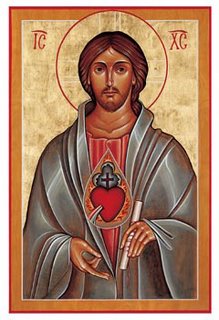 Pray in whatever fashion you might like; but, when it comes to praying for people in your life – coworkers, neighbors, enemies, family, friends, children, or all of them as one – focus on the grace pouring from Christ. How? As a Roman Catholic I am privileged to have a potent tradition of ‘the Sacred heart’ which helps catalyze my focus on Christ’s outpouring grace. With every breath in, I envision grace streaking like lightning from Christ’s pierced heart to my own piercing heart. His grace, that beautiful light, illuminates and swells, heats and melts, my own heart. Then, as I exhale, I envision the same grace surging from me, as through a conductor, to ‘hit’ other people.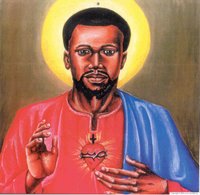
There are generally three ways I envision this explosion of grace. First, I may just imagine Christ’s lightning-like love engulfing the subject of my prayers like a camera flash. Second, since I live so far from so many people I love, I may imagine the grace shooting from me like supernatural lightning – or, like divine long-range missiles – to blast down on the ‘targets’ of my prayer. Third, which is my favorite way, I imagine grace streaking from me, in random array, and crawling at the speed of love over the floor, under doors, up legs, through flesh, to bury itself into someone’s heart. These bolts of grace may be broad like police DO NOT CROSS ribbons, or thread like tinsel or, at times, gold thread. (This is why I first called this practice ‘weaving with grace’.) The different sizes of depend on how genuine and zealous a prayer I ‘emit’ with that breath. In any case, the key is that these cords always find their target. (And yes, dear readers, more than a few of you are often my unsuspecting targets! Beware of falling grace!)
I like the third way of envisioning prayertechnics because it best conveys the feelings and ideas I have while I pray for others: urgency, speed, distance, intimacy, light, power. In fact, believe it or not, the image that I think best captures this vision of prayertechnics is the late great Tron. In that movie, the cars race along lit tracks at hyper-speeds leaving red and blue tracks of overlapping light behind them. If there is an obstacle, they veer left and right, relentlessly seeking the finish line. (Another possible image is that of electricity surging across a circuit board, twisting over and through every gleaming wire.)
Motion. Connection. Energy. Contact. Power, hope, life. With prayertechnics I am keenly aware of St. Paul’s words to the Romans:
 Regardless how far from someone I am, whether geographically, spiritually or emotionally, I trust God’s burning love can and does come to me just so I may pass it on to others. And ‘transmitting’ his love is not in vain. His love, propelled by faith in the ‘medium’ of the Holy Spirit, can and does reach its object. Just as Christ’s love bursts through my empty chest to fill me with light, life and love, so too may I expel that living light of love to others. The light of God’s love which He deigns to let me ‘transmit’ is, in the mystery of the Incarnation and Mystical Body, commingled with my own shabby love. By a dim analogy of grace, in which I am blessed to partake in the ministry of Christ, just as 'power came forth from him and healed them all' (Luke 6:19), so too I send out God’s love to others, vividly wrapping them in a golden cocoon of love, and even more vividly wrapping their hearts in the saving threads of love. As St. Paul says, ‘God's love has been poured into our hearts through the Holy Spirit... [so] the love of Christ controls us, because we are convinced that one has died for all; therefore all have died’ (Romans 5:5 and 2 Corinthians 5:14).
Like the other two ‘techniques’ I’ve discussed, prayertechnics is highly imaginative, or, highly vivid. With the prayer of the palms, you systematically imagine each of your ‘parts’ opening, like a palm, to God, neighbor and life. With cardiopnea, you vividly imagine inhaling the Crucified One, or any situation you find yourself in, into your heart and then committing it all expulsively back to God from your heart.
I mentioned in part II that cardiopnea works closely with the third method, prayertechnics, and here is why: prayertechnics is effectively a sub-technique of cardiopnea. Prayertechnics’ spiritual vividness is but a crystallization** of how cardiopnea works. The difference between them, however, is twofold. First, the latter is more general. I try to inhale my surroundings very broadly and without too much personal nattering. Otherwise, I may be distracted by analyzing minutiae. Prayertechnics, by contrast, is meant to be highly specific: names, faces, fine details, etc. A second difference is the, so to speak, direction and intent of the two prayer methods. Cardiopnea is meant to help *us* accept the workings of Providence in *our own* lives, and then, crucially, *commit it all back to God* in a broad, unqualified, unintentional way. Prayertechnics, by contrast, leads us to care for specific other people’s lives, and to commit them to God in the inscrutable web of Providence they find themselves in. More succinctly, cardiopnea is for us and God, whereas prayertechnics is for other people and God.
Enough ‘big picture’ – how does it work? Enter your darkened room. Kneel before a crucifix or an icon of Christ.
 Pray in whatever fashion you might like; but, when it comes to praying for people in your life – coworkers, neighbors, enemies, family, friends, children, or all of them as one – focus on the grace pouring from Christ. How? As a Roman Catholic I am privileged to have a potent tradition of ‘the Sacred heart’ which helps catalyze my focus on Christ’s outpouring grace. With every breath in, I envision grace streaking like lightning from Christ’s pierced heart to my own piercing heart. His grace, that beautiful light, illuminates and swells, heats and melts, my own heart. Then, as I exhale, I envision the same grace surging from me, as through a conductor, to ‘hit’ other people.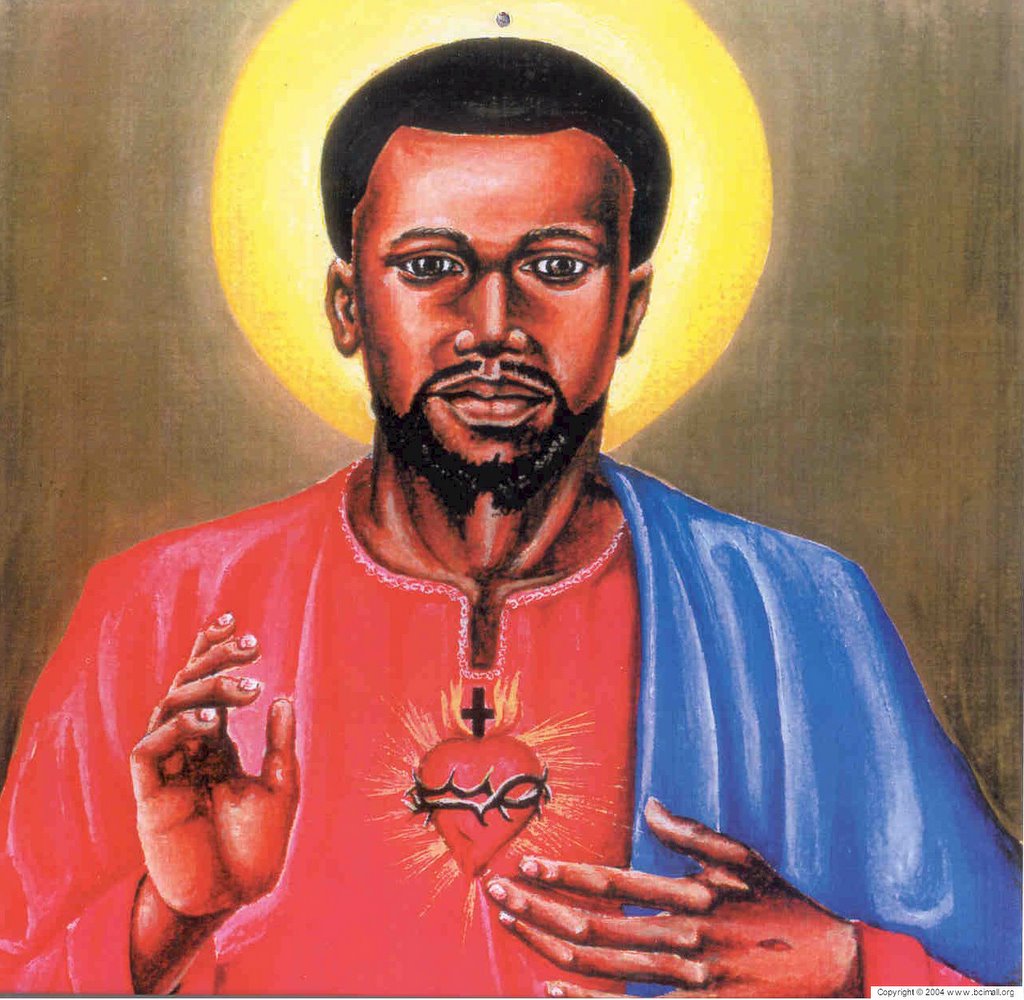
There are generally three ways I envision this explosion of grace. First, I may just imagine Christ’s lightning-like love engulfing the subject of my prayers like a camera flash. Second, since I live so far from so many people I love, I may imagine the grace shooting from me like supernatural lightning – or, like divine long-range missiles – to blast down on the ‘targets’ of my prayer. Third, which is my favorite way, I imagine grace streaking from me, in random array, and crawling at the speed of love over the floor, under doors, up legs, through flesh, to bury itself into someone’s heart. These bolts of grace may be broad like police DO NOT CROSS ribbons, or thread like tinsel or, at times, gold thread. (This is why I first called this practice ‘weaving with grace’.) The different sizes of depend on how genuine and zealous a prayer I ‘emit’ with that breath. In any case, the key is that these cords always find their target. (And yes, dear readers, more than a few of you are often my unsuspecting targets! Beware of falling grace!)
I like the third way of envisioning prayertechnics because it best conveys the feelings and ideas I have while I pray for others: urgency, speed, distance, intimacy, light, power. In fact, believe it or not, the image that I think best captures this vision of prayertechnics is the late great Tron.
 In that movie, the cars race along lit tracks at hyper-speeds leaving red and blue tracks of overlapping light behind them. If there is an obstacle, they veer left and right, relentlessly seeking the finish line. (Another possible image is that of electricity surging across a circuit board, twisting over and through every gleaming wire.)
 Motion. Connection. Energy. Contact. Power, hope, life. With prayertechnics I am keenly aware of St. Paul’s words to the Romans:
26: [T]he Spirit helps us in our weakness; for we do not know how to pray as we ought, but the Spirit himself intercedes for us with sighs too deep for words.
27: And he who searches the hearts of men knows what is the mind of the Spirit, because the Spirit intercedes for the saints according to the will of God.
28: We know that in everything God works for good with those who love him, who are called according to his purpose.
29: For those whom he foreknew he also predestined to be conformed to the image of his Son, in order that he might be the first-born among many brethren. ... 37: No, in all these things we are more than conquerors through him who loved us. 38: For I am sure that neither death, nor life, nor angels, nor principalities, nor things present, nor things to come, nor powers, 39: nor height, nor depth, nor anything else in all creation, will be able to separate us from the love of God in Christ Jesus our Lord.
 Regardless how far from someone I am, whether geographically, spiritually or emotionally, I trust God’s burning love can and does come to me just so I may pass it on to others. And ‘transmitting’ his love is not in vain. His love, propelled by faith in the ‘medium’ of the Holy Spirit, can and does reach its object. Just as Christ’s love bursts through my empty chest to fill me with light, life and love, so too may I expel that living light of love to others. The light of God’s love which He deigns to let me ‘transmit’ is, in the mystery of the Incarnation and Mystical Body, commingled with my own shabby love. By a dim analogy of grace, in which I am blessed to partake in the ministry of Christ, just as 'power came forth from him and healed them all' (Luke 6:19), so too I send out God’s love to others, vividly wrapping them in a golden cocoon of love, and even more vividly wrapping their hearts in the saving threads of love. As St. Paul says, ‘God's love has been poured into our hearts through the Holy Spirit... [so] the love of Christ controls us, because we are convinced that one has died for all; therefore all have died’ (Romans 5:5 and 2 Corinthians 5:14).

This is what it means to be Catholic
Don’t laugh now. I know: I mentioned the following anecdote almost three months ago and am only now giving up the goods. It’s only a little story; I’ve had plenty of time to write it; it’s returned vividly to my mind nearly every week since it happened. But, eh, life happens; I do what I can do. Read what you can read.
So, weeks ago, I agreed to visit a monastery in central Táiwān with two close friends from my parish. Filipinos, they have lived in Táiwān nearly thirty years. During that time they have become third-order members of the Community of St. John, which was founded in the 1970s by the Dominican Father Dominique Philippe. Knowing I am discerning my vocation, and hearing I have interest in “getting away” now and then for spiritual retreats, we all got in the car to visit Fr. Francois and his little community. Mass began a little after we arrived. I braced myself for yet another Mass in Chinese – but then was thrown for a loop. Minute after minute, as I strained harder and harder to understand Fr. Francois, I was increasingly unnerved. I simply had no idea what Fr. Francois was saying! Stranger still, next to me my friend, Cisco (short for Francisco), was apparently not missing a beat; in fact, he leaned over every few moment to whisper (a translation? A question?) to his wife. All I could do was blink and go along by faith even more ineptly than usual. Was it simply Father’s theek Frawnsh aksent? Or was my Chinese really that bad? The strangest thing was that when another priest read the responsorial, I understood him much better, despite his admittedly very theek aksent.
Suddenly, perhaps registering my bafflement, and seeing Cisco’s whispered translations, Fr. Francois asked in what I knew was Taiwanese: “Lín tyā’wù bo?” Eureka. Fr. Francois had been reading and preaching in Taiwanese! (I never claimed to be smart.) After Mass things became a little clearer. Because Fr. Francois lives and serves in rural Táiwān, he decided to learn Taiwanese, and in fact, not to learn Mandarin. Cisco could understand him and speak back because his family was originally from the Fujian province of China, which is, if I’m not mistaken, more or less where the Taiwanese dialect (“Amoy”) originated. At lunch we ate with a Taiwanese, shall I say “solidarity”, group dedicated to raising public virtue and self-responsibility. Turning to his left, Fr. Francois spoke in Taiwanese; turning to us on his right, he alternated between bursts of Tagalog with Cisco and his wife and English with me. (Oh, yes, I also made feeble attempts to use what little French I had by then learned. Très pitoyable!)
After lunch, we gathered in an adjoining room for some singing and chitchat. There I heard hymns in French, Latin and Taiwanese and joined some in Mandarin and English. Once most of the people had left, while Fr. Francois talked with Cisco and his wife, I was able to talk with a French brother, whom, as a matter of fact, I had met months before after he and his community performed a splendid musical Christmas drama. We exchanged English, French, Chinese and even German tips as we discussed theology, history, vocation and the upcoming World Youth Day. Yes, he would be going too.
A little after this we made our last stop a few miles down the road at the convent. There I spoke with a couple French sisters and finished by talking briefly with an Argentinean sister – to whom, as a matter of fact, I already had an oblique connection. Months before she was studying at Providence and had joined us for a few Taizé services. On top of that, my godmother, Sister Regina, some months ago told me the case of a woman in Britain, who was, if I’m not mistaken the sister or law, or at least close friend, of the Argentinean sister I met in the convent. The woman in Britain had been attacked by a man while brining her child home; in fact, he stabbed her in the neck, paralyzing her from the wound down. Happily, though, Sister Regina told me this very case, as a sort of “cause for beatification”, was being entrusted to the prayers of the late and dear Pope John Paul II, who had died only a few weeks prior to my hearing this. Since hearing it, I have prayed fairly regularly for his intercession on behalf of that poor paralyzed woman. (Join me!) And then, there I was, standing in a convent speaking with the sister so closely, and yet so obliquely, connected to my formation as a new Catholic.
On the ride back, everything hit me at once in a kind of spiritual, cultural epiphany. So this is what it means to be Catholic! To ride with Filipino friends to a convent of a French religious order in rural Táiwān; to hear a Chinese Mass led mostly in Taiwanese by a French priest, while my Filipino friend used his Chinese heritage to translate for his wife into tagalong; to eat lunch with total strangers in the company of brethren, while practicing my Mandarin, Tagalog and French; to catch up with a brother I barely knew by talking about “deep things” and then to make plans to meet in Germany (alas, didn’t happen); to make the acquaintance of a sister from South America for whose friend I had already been praying, with the special assistance of a recently deceased Polish bishop of Rome; and, finally, to experience all this as a German-speaking Greek-American living in Táiwān, a land which had been occupied by the Dutch, Portuguese, Chinese and Americans; and all this because the teaching, example, death and resurrection of an ancient Jewish teacher from Nazareth had reached me through the witness and wisdom of two millennia of Greek, Roman, African, German, Russian, Filipino, Portuguese, Spanish, Italian, French, Lebanese, Scottish, Frisian, Chinese, Japanese, English and American believers.
Obviously, similar concatenations and relations could be concatenated and related in, probably, most any religious, or even secular, community. But, by and large, they never are. Why? Because, more than in any other affiliation, such concatenated relatedness is what it means to be a Catholic. We worship a God who is perfect relationship. We worship a Lord who has become related to us in every way, particularly in our sufferings and His. We worship a God who calls us to meet all people in all times, just as He met us in one Person at one Time. We worship in the multicultural, multigenerational and multidimensional unity of all the faithful, both alive and dead, both penitent and purified. As the saying goes: “The Catholic Church? Here comes everybody.” In the early days of feeling my way into the Church, I emailed a very prominent Catholic blogger (three guesses who he is) about my hopes, fears and incipient “connections” in the Church. I forget nearly everything he said but this: “The Catholic faith is extremely ecological.” I pondered that for some time. And then, three years later, I saw exactly what he meant on my way back from a convent in rural Táiwān.
"At long last!" (part XYZ)
From the bottomless FCA backlog, I give you, at last: the pre-WYD “crisis”! You know, the one I had at work and hyped shortly before going to WYD in August. Considering my recent "This is me lately" post, now is, I think, the right time to give up the goods. Remember, though: this was MY crisis, and while things have advanced past it, at the time it was a true crisis for me... so don't be let down by the end of this post, sighing, "You mean... that was it?"
So much time has passed that it is now, ironically, easier to describe my little crisis than when it was actually happening. In fact, let me be so Orphic as to condense the story into a crude spoken voice poem (opa, everybody’s favorite!). try not to nod your head too sharply in syncopated time.
In other words, despite the fact that I had announced my travel plans weeks before leaving, despite the fact that before re-signing my contrast I had mentioned explicitly the conflict of dates, despite the fact that I’d never heard a single negative word, and despite the fact that I had arranged for a qualified sub, and despite my friends continuous encouragement “it’ll all be okay” – despite all this, only days before leaving for Germany, I was asked point-blank: “Elliot, is there any way you can change the dates? Do you know the deans are not happy about this? Are you still willing to go, even if you lose your job?”
Hearing it like this, I’m certain you can’t grasp how cataclysmic this episode was for me. But I tell you: this was one of the defining moments of my life. I have always had “issues” with money; not the least because Jesus reifies it as, perhaps, the chief rival of God’s sovereignty in our lives (as well as the fact that St. Paul describes the love of money as the root of all evils!). I have always insisted on “putting God first” in my life, and not merely psychologically or subjectively, but in terms of my daily, practical, demonstrable “life patterns”. At the same time, I felt an increasing burden, sometimes amounting to a palpable ache, to have more time for “ministry-type stuff” (e.g., personal academic formation, personal spiritual formation, personal-level outreach, etc.).
And then all of a sudden -- as close to “out of the blue” as I can imagine from my own life – one morning I was asked point blank: “Will you serve God or Mammon? Will you sacrifice your job for the Kingdom? Will you conform or be transformed?” And, amazingly, I said yes to God, to His Kingdom, to His priorities. All of a sudden, before I’d even reached my desk for the day, I was suspended over a menacing abyss, swaying beside a saving ledge. Below, God and the risk of unemployment from a job I love, from the money I live by, and from the security I have come to enjoy. At my side, Mammon’s reassuring S-shaped hook-hand, the peace of fiscal security, the stable-looking ledge of complying “sensibly”, and the slavish desire to please my “overs”. To sway forever, indeterminately, would be to fatigue and rot. Only one way: let go; answer; jump; fall.
And fall I did! I simply let go.
The only thing more incredible than my supervisor’s pointed questions were the words that came out of my mouth. “Yes, Supervisor, I am willing to lose my job. I made my priorities clear long ago. And, while I love this job and my students, my life, Supervisor, is more than my job, more than money. I must serve God first.” I couldn’t believe I was actually saying this, and so promptly! And I did so with your help. With your prayers. As I wrote in the midst of this crisis (here and here), I felt the effects of prayer almost like invisible water currents surging around me. Even now, the memories of such consolations warms my heart.
Why is now such an apt time to disclose this? Because I’ve reached a similar crisis point, albeit by different means and, in fact, not even on account of myself. (Smile: no spoken word this time.) In exactly fifty words: Two weeks ago my supervisor told our office assistant, my friend “Vanessa”, she can no longer leave campus for lunch. No reason. “Vanessa” complained, mildly, to the deans, which led our supervisor to chastise her and (successfully!) alter her contract: no lunch break, albeit with a slightly earlier departure time. I was absolutely incensed! I was, and am, ready to quit over this. It’s basic labor injustice of the most petty kind, and has apparently received full administrative approval. Even if “Vanessa” weren’t my friend, I’d still have to protest. If they can so easily edit her contract (and during a semester!), none of our contracts is safe either. Further, “Vanessa” is and has been an integral part of our program, and I simply won’t abide my supervisor trying to tyrannize us.
Things are still up in the air, but already “Vanessa” has had to spend two days on campus, exactly as the deans instructed her to do according to our supervisor’s whims. I'm encouraged in my zeal by the fact that I am not the only one incensed by this tyranny. Even without peer outrage, however, I am compelled to press this issue. "Vanessa" said to me a few days ago, "Kust so you know, I think you're right." I thanked her for her vote of confidence, but quickly added, "I know I'm right." "Vanessa" has also told me numerous times to be careful, not to be too brash. "Be careful?" I reply, "Careful about what? Doing the right thing? This is not a mere 'cultural difference'. This is WRONG, and I would be too if I don't fight for what is RIGHT."
On the one hand, this it not, strictly, your fight; so you may find this whole post petty and insular. On the other hand, at the risk of melodrama, I think it is your fight, since justice is the fight of all people of good will. I began this here “crisis” post with recollections of answered prayer; I close it with a call for more prayer. My anger has subsided a lot over the past few days, but only in terms of emotional intensity. In terms of my determination to make a stink in the name of justice, I am not one iota less zealous.
Please pray for this situation and for my heart. Do so in the Spirit, and, more exactly, in the spirit of Psalm 99:
So much time has passed that it is now, ironically, easier to describe my little crisis than when it was actually happening. In fact, let me be so Orphic as to condense the story into a crude spoken voice poem (opa, everybody’s favorite!). try not to nod your head too sharply in syncopated time.
A boy abroad. A boy without a broad.
Work the work.
Working.
Working the work.
A dawn alights.
World
Youth
Day
Germany.
Not work. Germany.
Permission.
Seek, seeking.
Sought permission.
An absence of leave
Without a leave of absence.
Supervisor.
Tell, telling.
Told supervisor.
Weeks advance, weeks decline.
Event looms.
Looming like an event.
Like a loom in the mill.
Teacher anxious.
Teach, teaching.
Taught, too much.
A break?
A breaking point?
Burning, for burnout?
Supervisor. Confrontation.
Confront, confronting.
Supervisor confronted teacher.
Would you, you could, will you still go?
Even if you lose,
loose,
your job?
Would I, could I, should I, will I still go?
If my job doesn’t cut me a break for a break?
I would go, I should go, I will go!
For Christian I am!
Brooding. Waiting.
Sweat beads. Hands clammy.
Time ticks, nervous ticks.
My job: no time now: time to teach these dear students.
Time ticks. Bells ring.
Supervisor. Prayor.
Readers. Prayers.
A showdown: the test of wills,
the test of allegiance.
God embraces; Mammon glares.
Second meeting: negotiation.
Second brooding: anticipation.
Loose, loosing.
Job to be loosed, at last?
Sweat beads. Students clamber in.
No time now: time to teach.
A rupture in the ceiling.
A breach in the darkness above.
Light streams in, rafted in on prayers.
Mammon tumbles, howling.
God howls, lighting, battering, embracing.
Sweat beads vanish. Bells ring.
Third meeting: green light.
Peace, joy, thanks – the teacher embraced.
In other words, despite the fact that I had announced my travel plans weeks before leaving, despite the fact that before re-signing my contrast I had mentioned explicitly the conflict of dates, despite the fact that I’d never heard a single negative word, and despite the fact that I had arranged for a qualified sub, and despite my friends continuous encouragement “it’ll all be okay” – despite all this, only days before leaving for Germany, I was asked point-blank: “Elliot, is there any way you can change the dates? Do you know the deans are not happy about this? Are you still willing to go, even if you lose your job?”
Hearing it like this, I’m certain you can’t grasp how cataclysmic this episode was for me. But I tell you: this was one of the defining moments of my life. I have always had “issues” with money; not the least because Jesus reifies it as, perhaps, the chief rival of God’s sovereignty in our lives (as well as the fact that St. Paul describes the love of money as the root of all evils!). I have always insisted on “putting God first” in my life, and not merely psychologically or subjectively, but in terms of my daily, practical, demonstrable “life patterns”. At the same time, I felt an increasing burden, sometimes amounting to a palpable ache, to have more time for “ministry-type stuff” (e.g., personal academic formation, personal spiritual formation, personal-level outreach, etc.).
And then all of a sudden -- as close to “out of the blue” as I can imagine from my own life – one morning I was asked point blank: “Will you serve God or Mammon? Will you sacrifice your job for the Kingdom? Will you conform or be transformed?” And, amazingly, I said yes to God, to His Kingdom, to His priorities. All of a sudden, before I’d even reached my desk for the day, I was suspended over a menacing abyss, swaying beside a saving ledge. Below, God and the risk of unemployment from a job I love, from the money I live by, and from the security I have come to enjoy. At my side, Mammon’s reassuring S-shaped hook-hand, the peace of fiscal security, the stable-looking ledge of complying “sensibly”, and the slavish desire to please my “overs”. To sway forever, indeterminately, would be to fatigue and rot. Only one way: let go; answer; jump; fall.
And fall I did! I simply let go.
The only thing more incredible than my supervisor’s pointed questions were the words that came out of my mouth. “Yes, Supervisor, I am willing to lose my job. I made my priorities clear long ago. And, while I love this job and my students, my life, Supervisor, is more than my job, more than money. I must serve God first.” I couldn’t believe I was actually saying this, and so promptly! And I did so with your help. With your prayers. As I wrote in the midst of this crisis (here and here), I felt the effects of prayer almost like invisible water currents surging around me. Even now, the memories of such consolations warms my heart.
Why is now such an apt time to disclose this? Because I’ve reached a similar crisis point, albeit by different means and, in fact, not even on account of myself. (Smile: no spoken word this time.) In exactly fifty words: Two weeks ago my supervisor told our office assistant, my friend “Vanessa”, she can no longer leave campus for lunch. No reason. “Vanessa” complained, mildly, to the deans, which led our supervisor to chastise her and (successfully!) alter her contract: no lunch break, albeit with a slightly earlier departure time. I was absolutely incensed! I was, and am, ready to quit over this. It’s basic labor injustice of the most petty kind, and has apparently received full administrative approval. Even if “Vanessa” weren’t my friend, I’d still have to protest. If they can so easily edit her contract (and during a semester!), none of our contracts is safe either. Further, “Vanessa” is and has been an integral part of our program, and I simply won’t abide my supervisor trying to tyrannize us.
Things are still up in the air, but already “Vanessa” has had to spend two days on campus, exactly as the deans instructed her to do according to our supervisor’s whims. I'm encouraged in my zeal by the fact that I am not the only one incensed by this tyranny. Even without peer outrage, however, I am compelled to press this issue. "Vanessa" said to me a few days ago, "Kust so you know, I think you're right." I thanked her for her vote of confidence, but quickly added, "I know I'm right." "Vanessa" has also told me numerous times to be careful, not to be too brash. "Be careful?" I reply, "Careful about what? Doing the right thing? This is not a mere 'cultural difference'. This is WRONG, and I would be too if I don't fight for what is RIGHT."
On the one hand, this it not, strictly, your fight; so you may find this whole post petty and insular. On the other hand, at the risk of melodrama, I think it is your fight, since justice is the fight of all people of good will. I began this here “crisis” post with recollections of answered prayer; I close it with a call for more prayer. My anger has subsided a lot over the past few days, but only in terms of emotional intensity. In terms of my determination to make a stink in the name of justice, I am not one iota less zealous.
Please pray for this situation and for my heart. Do so in the Spirit, and, more exactly, in the spirit of Psalm 99:
The Lord is King: let the peoples tremble;
he is enthroned above the cherubim:
let the earth shake.
The Lord is great in Zion
and high above all peoples.
Let them praise your name, which is great and awesome;
the Lord our God is holy.
Mighty king, who loves justice, you have established equity;
you have executed justice and righteousness in Jacob.
Exalt the Lord our God;
bow down before his footstool, for he is holy.
Moses and Aaron among his priests
and Samuel among those who call upon his name;
they called upon the Lord and he answered them.
He spoke to them out of the pillar of cloud;
they kept his testimonies and the law that he gave them.
You answered them, O Lord our God;
you were a God who forgave them
and pardoned them for their offences.
Exalt the Lord our God and worship him upon his holy hill, for the Lord our God is holy.
Friday, December 2, 2005
Good news!
After two-plus years of being merely a studious teacher-missionary, I am now *officially* a student-teacher-missionary ("at" CDU www.cdu.edu)!
After weeks of thumbing moronically through a printed application, unsure how to fill it out and when it must be mailed, I completed the online application today at lunch in five minutes. (Yes, I printed the application from the same place I applied today. ::sigh -- head hanging in techy-shame::) All I must do now is wait for my materials to arrive in the mail, and then I'll be on my way to completing the graduate pre-req, "Catechism of the Catholic Church" (for credit), and can then enter the graduate curriculum proper (MA, not MRS).
As I mentioned, taking up this extra work "in the vineyard of the Lord" (cf. Isa 5:7) means leaving aside other tasks -- like blogging. Look for the following resolutions to show up here in the next few minutes to weeks:
1) No alcohol until Christmas.
2) No Internet after 11 PM until...?
3) No blogging (as a commenter or a poster) until I get Confirmed. (Bishop, on your mark.)
These things, except 1), which began last night, are subject to change until I make a semi-formal vow to God. But, they look pretty good to me at this time. Because I very much want to cut back on posting and dig into, the remaining series I have slated for FCA are increasingly weighing on me. It's not that I don't want to write them; quite the opposite: I want to write them so badly that they're taunting non-existence is eating at me. The pile of proposed words towers before me like a shrouded mountain; but I am determined to climb, crawl, scratch, scream, kick and fight my way to the top, with little to no loss of what I consider quality work. (Better not to sit than to post shit. Or, as Hemingway said, “The first draft of anything is shit.” I know because I have that quote taped upon my wall. Ah, the consolations of inspiration!)
I don't think I've ever disclosed it here, but a few years back I rode a bike from Pueblo, CO to (more or less) D.C. to way-southern-Georgia. (My last stop was a flooded house on the very street where Forrest, Forrest Gump, ran his leg braces off. Need I mention the trip was awesome?) Deep into Kentucky I decided to take a "shortcut"... which brought me not only through the turf of two massive German shepherds -- both of whose backs easily reached my hips as they ran beside me -- and up "Black Bear Mountain". (Need I mention I wanted to cry, literally, when I saw the sign, then after six or seven hours of riding that day?) Fortunately my two German friends motivated me onto the foot of BBM. Unfortunately, everything else about that damned bear weighed against me: the fatigue, the soreness, the humidity, the disorientation, the incline, the unpaved stretches of road, the invisible peak, etc. At one point, I was driving each pedal stroke down like a man walking, left... right... left... right. More than once I had to stop and rest, straddling my bike in outraged near-defeat. But I kept mounting, pedaling, advancing, climbing. The darkest moments came when I could almost feel the bear pushing me back with his granite claws. It was then, though, that I stepped in and literally screamed at the mountain. (I did the same in the Ozarks of Kentucky.) How I hated that mountain! And yet how I loved it! I hated it because it would not stoop down for my sake. And, yet, I loved it because it -- he -- had, in a strange way, waited all this time for me to challenge him, to scream at him, to lose myself in his gravelly hide. I crested the hill and rolled down his back into further adventures of Providence.
So it is with these blasted writing projects. I am determined to crest them, and to do with quality work. Countless times in the past few weeks I have surprised myself with my own emotions: gritted teeth as I open Word; cursing my notes as they sit there, clear and complete, but still unwritten; a sudden angry depression which makes me just want to lie down and forget about "all those words, words, words!" (At FCA the motto may as well be, “Accuracy by volume!”) Hemingway called the blank page a white bull. And, until recently, I had only a dim sense of how right he is. For a writer, the unwritten word is a constant thorn in the side; the unarticulated word is a constant ache in the spirit. The only way to kill that beast is to let it out its cage, the word-cluttered mind, and to let it stampede someone else at last. The only way to silence the empty bull’s brutal, jeering snorts is to give it voice outside your own mind. To escape the leering bull you must face him; to kill him you must give him life. Facing, corralling and killing the bull, however, is much easier said than done. Writing is hard work. I know now better than I ever did before.
My point? Please pray for me. Apart from my own fallen indiligence, confusion, error, apathy and exhaustion, at times I feel a genuine spiritual opposition against my work here, which shouldn't be a surprise since I aim always, even in levity, to demolish the works of the Enemy with the words of our Lord, the Truth. I've said it before and I’ll say it again: I write not only to kill the bull within, but also for you, and, above all, for God. Fides, cogitation, actio, ad majorem Dei gloriam. I feel His tender hooks in me (as well as perhaps His tenterhooks), pulling me to write; but I also feel the terrible hooks of the flesh and the Enemy pulling the other way, to brush it off, to keep it to myself, to put it off another day, to ease back, etc.
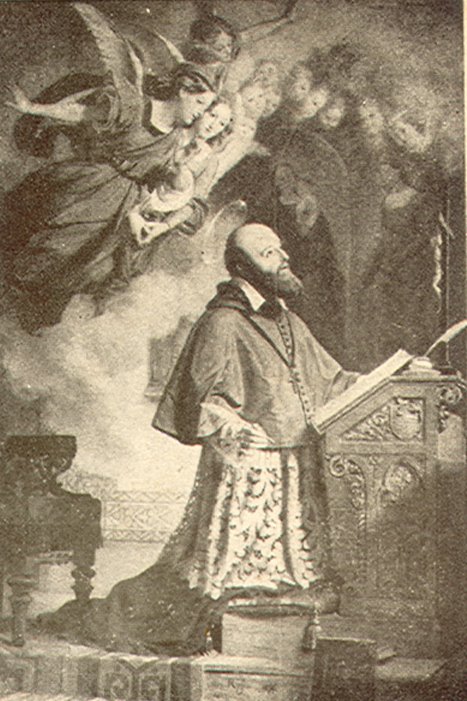
Dear St. Francis, my patron saint, and patron of writers, please pray for me!

After weeks of thumbing moronically through a printed application, unsure how to fill it out and when it must be mailed, I completed the online application today at lunch in five minutes. (Yes, I printed the application from the same place I applied today. ::sigh -- head hanging in techy-shame::) All I must do now is wait for my materials to arrive in the mail, and then I'll be on my way to completing the graduate pre-req, "Catechism of the Catholic Church" (for credit), and can then enter the graduate curriculum proper (MA, not MRS).
As I mentioned, taking up this extra work "in the vineyard of the Lord" (cf. Isa 5:7) means leaving aside other tasks -- like blogging. Look for the following resolutions to show up here in the next few minutes to weeks:
1) No alcohol until Christmas.
2) No Internet after 11 PM until...?
3) No blogging (as a commenter or a poster) until I get Confirmed. (Bishop, on your mark.)
These things, except 1), which began last night, are subject to change until I make a semi-formal vow to God. But, they look pretty good to me at this time. Because I very much want to cut back on posting and dig into, the remaining series I have slated for FCA are increasingly weighing on me. It's not that I don't want to write them; quite the opposite: I want to write them so badly that they're taunting non-existence is eating at me. The pile of proposed words towers before me like a shrouded mountain; but I am determined to climb, crawl, scratch, scream, kick and fight my way to the top, with little to no loss of what I consider quality work. (Better not to sit than to post shit. Or, as Hemingway said, “The first draft of anything is shit.” I know because I have that quote taped upon my wall. Ah, the consolations of inspiration!)
I don't think I've ever disclosed it here, but a few years back I rode a bike from Pueblo, CO to (more or less) D.C. to way-southern-Georgia. (My last stop was a flooded house on the very street where Forrest, Forrest Gump, ran his leg braces off. Need I mention the trip was awesome?) Deep into Kentucky I decided to take a "shortcut"... which brought me not only through the turf of two massive German shepherds -- both of whose backs easily reached my hips as they ran beside me -- and up "Black Bear Mountain". (Need I mention I wanted to cry, literally, when I saw the sign, then after six or seven hours of riding that day?) Fortunately my two German friends motivated me onto the foot of BBM. Unfortunately, everything else about that damned bear weighed against me: the fatigue, the soreness, the humidity, the disorientation, the incline, the unpaved stretches of road, the invisible peak, etc. At one point, I was driving each pedal stroke down like a man walking, left... right... left... right. More than once I had to stop and rest, straddling my bike in outraged near-defeat. But I kept mounting, pedaling, advancing, climbing. The darkest moments came when I could almost feel the bear pushing me back with his granite claws. It was then, though, that I stepped in and literally screamed at the mountain. (I did the same in the Ozarks of Kentucky.) How I hated that mountain! And yet how I loved it! I hated it because it would not stoop down for my sake. And, yet, I loved it because it -- he -- had, in a strange way, waited all this time for me to challenge him, to scream at him, to lose myself in his gravelly hide. I crested the hill and rolled down his back into further adventures of Providence.
So it is with these blasted writing projects. I am determined to crest them, and to do with quality work. Countless times in the past few weeks I have surprised myself with my own emotions: gritted teeth as I open Word; cursing my notes as they sit there, clear and complete, but still unwritten; a sudden angry depression which makes me just want to lie down and forget about "all those words, words, words!" (At FCA the motto may as well be, “Accuracy by volume!”) Hemingway called the blank page a white bull. And, until recently, I had only a dim sense of how right he is. For a writer, the unwritten word is a constant thorn in the side; the unarticulated word is a constant ache in the spirit. The only way to kill that beast is to let it out its cage, the word-cluttered mind, and to let it stampede someone else at last. The only way to silence the empty bull’s brutal, jeering snorts is to give it voice outside your own mind. To escape the leering bull you must face him; to kill him you must give him life. Facing, corralling and killing the bull, however, is much easier said than done. Writing is hard work. I know now better than I ever did before.
My point? Please pray for me. Apart from my own fallen indiligence, confusion, error, apathy and exhaustion, at times I feel a genuine spiritual opposition against my work here, which shouldn't be a surprise since I aim always, even in levity, to demolish the works of the Enemy with the words of our Lord, the Truth. I've said it before and I’ll say it again: I write not only to kill the bull within, but also for you, and, above all, for God. Fides, cogitation, actio, ad majorem Dei gloriam. I feel His tender hooks in me (as well as perhaps His tenterhooks), pulling me to write; but I also feel the terrible hooks of the flesh and the Enemy pulling the other way, to brush it off, to keep it to myself, to put it off another day, to ease back, etc.
Dear St. Francis, my patron saint, and patron of writers, please pray for me!
Food for thought indigestion
I am so humble I won't even admit it.
I am so ignorant I don't even know it.
I am so deluded I won't even face that fact.
Carry on.
I am so ignorant I don't even know it.
I am so deluded I won't even face that fact.
Carry on.
Subscribe to:
Posts (Atom)